- Home
- Plant guide
- Autumn Sage
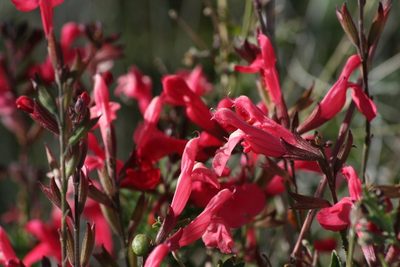
Luis F. Ramírez (CC BY)
Autumn Sage
Salvia greggii
A tough little evergreen sage that feeds hummingbirds from spring to frost in Texas and the Southwest.
Native to: the desert Southwest
Growing Autumn Sage
Shear lightly midsummer for a fresh flush of bloom. Practically evergreen in mild winters and unbothered by heat, drought, or deer.
Where it belongs
Autumn sage is native to the Chihuahuan Desert region of the Southwest and adjacent Mexico, growing on rocky limestone slopes, in canyons, and along dry washes.
The common name is misleading. It does not wait for autumn. In Texas and the Southwest it starts in April and keeps flowering until frost, pausing only in the worst of the summer heat, so it is a whole-season plant rather than a fall one.
It sits somewhere between a perennial and a shrub. The base goes woody, the plant holds its leaves through mild winters, and it can be pruned into a low informal hedge.
Growing it
Full sun to part sun, dry soil, in rocky ground, loam, or sand, zones 7 to 10. Two to three feet, and about as wide.
Drainage and heat. It is genuinely unbothered by drought, reflected heat off paving, and poor rocky soil, and it declines in heavy wet ground.
Shear it back by a third in midsummer, after the first long flush. This produces a compact plant and a fresh round of bloom for fall, and it prevents the sparse woody look that unpruned plants develop. Cut it back harder, by half, in late winter.
It is sold in a wide range of flower colors, from scarlet through coral and pink to white, and all of them are selections of the same species. Red and coral draw hummingbirds most strongly.
What it feeds
The flowers are small hooded tubes held in loose spikes, and hummingbirds work them constantly. In much of Texas and the Southwest this is the backbone plant of a hummingbird garden, mainly because the bloom season is so long that it covers spring migration, the breeding season, and fall migration in one plant.
Bees take nectar, sometimes cutting in at the base of the tube. Butterflies visit in numbers, especially in fall.
Pair it with flame acanthus for high summer and firecracker penstemon for early spring, and a small dry garden can feed hummingbirds nine months of the year.
Living with it
Deer avoid it. The foliage is aromatic and unpalatable, which makes it one of the more reliably deer-resistant flowering plants in Hill Country gardens.
In zone 7 it can be killed to the ground by a hard freeze and usually returns from the root. Do not cut the dead top growth until you see new growth in spring, since the old stems protect the crown.
It roots easily from cuttings, which is the cheap way to fill a long border.
Sources: USDA PLANTS Database (native range); Lady Bird Johnson Wildflower Center, University of Texas at Austin (species profile and pruning); Texas A&M AgriLife Extension (regional garden performance).
It’s deer-resistant, drought-tolerant, long-blooming, and evergreen.Where it grows
Autumn Sage is native to the desert Southwest. In the wild you’ll find it across Arizona · California · Nevada · New Mexico · Texas · Utah. Always confirm it suits your specific county with your state native plant society before planting.
Regional Garden has written state guides covering Autumn Sage in 6 of them so far.
Good for
Where to buy Autumn Sage
Some links here are affiliate links and we may earn a small commission at no extra cost to you.
What a first-year Autumn Sage planting needs, from a pH kit to mulch.
Companions & kin.
Natives that share Autumn Sage’s range and conditions.
Flame Acanthus
Anisacanthus quadrifidus var. wrightii
A heat-loving shrub covered in tubular orange flowers through the hottest, driest weeks of summer.
- Full sun
- Dry
- 2–4 ft
- Blooms Jun–Oct
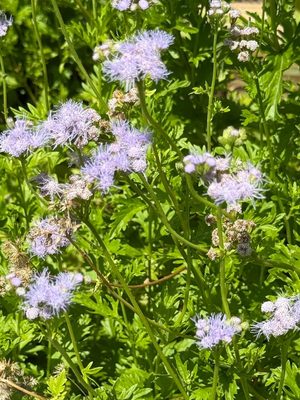
Gregg's Mistflower
Conoclinium greggii
Fuzzy blue flowers that act like a magnet for queen and monarch butterflies in the Southwest.
- Full–part sun
- Dry–average
- 1–2 ft
- Blooms May–Oct

Golden Currant
Ribes aureum
Yellow spring flowers that smell of cloves, black fruit birds strip in a week, and red foliage in the fall.
- Full–part sun
- Dry–average
- 4–8 ft
- Blooms Apr–May
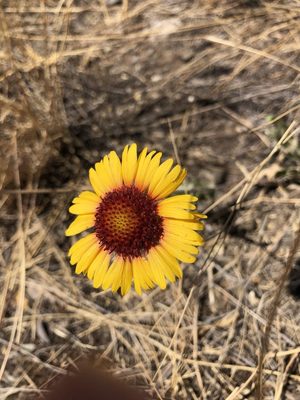
Blanketflower
Gaillardia aristata
Fiery red-and-gold wheels that bloom nonstop all summer on hot, dry, sandy ground.
- Full sun
- Dry
- 1–2.5 ft
- Blooms Jun–Sep