- Home
- Collections
- Hummingbirds
Native Hummingbird Plants
Tubular, nectar-heavy native flowers that draw hummingbirds far more reliably, and more safely, than any sugar-water feeder.
The flowers are built for the birds, literally
Hummingbird-pollinated flowers share a set of features that are not coincidental. They are usually red or orange, because birds see red well and most insects see it poorly, so the color advertises to birds and hides from nectar thieves. They are long narrow tubes, matched to a bill and tongue. They hold a lot of dilute nectar. And they typically have no scent and no landing platform, since a bird hovers and does not need one and cannot smell much anyway.
Cardinal flower, trumpet honeysuckle, scarlet beebalm, firecracker penstemon, autumn sage, Turk's cap, crossvine, and red-flowering currant all show the pattern.
Timing is the part most gardens get wrong
A hummingbird's year has three phases with different demands, and a garden that only covers midsummer misses two of them.
Spring migration is the hardest. Birds arrive in the North and along the Gulf coast weeks before the summer flowers open, and after crossing the Gulf they arrive nearly out of reserves. In the East, wild columbine, crossvine, and red-flowering currant in the Northwest are the plants that meet them.
Breeding season is easy. Everything is in bloom.
Fall migration matters again, and heavily. Birds leaving in September need to build fat for the trip. Cardinal flower, Turk's cap, autumn sage, and Gregg's mistflower carry that end.
Look at the collection with dates in mind rather than picking the showiest three.
Plants versus feeders
Feeders work and they are not wrong. Plants are better for reasons that are practical rather than sentimental.
Sugar water is carbohydrate only. Hummingbirds get their protein from small insects and spiders, and a garden with flowers has those; a feeder does not. Feeders also require serious upkeep, since sugar water ferments and grows mold fast in heat, and a neglected feeder makes birds ill. Two to three cleanings a week in summer is the standard, and most people do not manage it.
If you do use one, four parts water to one part plain white sugar, no dye, no honey, and clean it on schedule.
Plants need none of that and feed the insects too.
Practical siting
Hummingbirds are territorial and defend a food source, so scattering plants in a few groups around the yard supports more birds than one concentrated planting.
Put something near a window. The reason to grow these plants is to watch them work, and a vine on a trellis at eye level does that better than a bed at the back fence.
Leave some small dead branches as perches. Hummingbirds spend most of the day sitting, and they choose spots that overlook their flowers.
Sources: Cornell Lab of Ornithology (hummingbird biology, migration timing, and feeder maintenance guidance); Lady Bird Johnson Wildflower Center, University of Texas at Austin (hummingbird plant lists by region); Audubon (migration corridors and native plant selection).
28 native species in this collection.
Hummingbirds are wired to investigate red and orange tubular flowers, so a few well-placed natives will out-pull a feeder and never need cleaning. Stagger bloom times so there is nectar from spring migration through fall departure, and plant near a perch or shrub where the birds can rest between feedings.
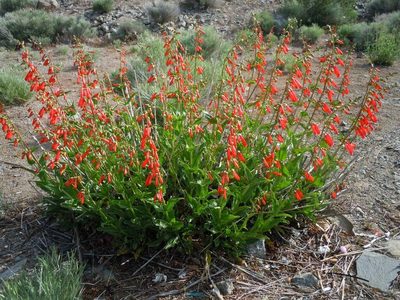
Firecracker Penstemon
Penstemon eatonii
Scarlet tubular flowers timed to the spring hummingbird migration through the desert Southwest.
- Full sun
- Dry
- 1.5–3 ft
- Blooms Mar–May
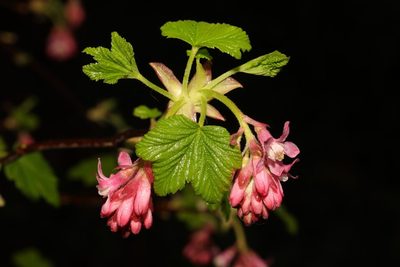
Red-Flowering Currant
Ribes sanguineum
Cascades of rose-pink tassels timed exactly to the return of the rufous hummingbird each spring.
- Full–part sun
- Dry–average
- 5–9 ft
- Blooms Mar–Apr
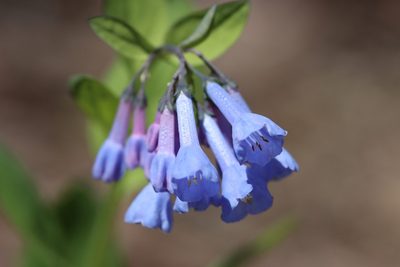
Virginia Bluebells
Mertensia virginica
Pink buds opening to drifts of sky-blue bells, then vanishing underground by summer.
- Part shade
- Average–wet
- 1–2 ft
- Blooms Mar–May
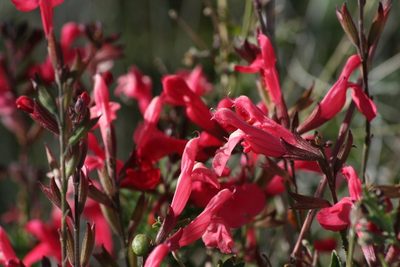
Autumn Sage
Salvia greggii
A tough little evergreen sage that feeds hummingbirds from spring to frost in Texas and the Southwest.
- Full–part sun
- Dry
- 2–3 ft
- Blooms Apr–Oct
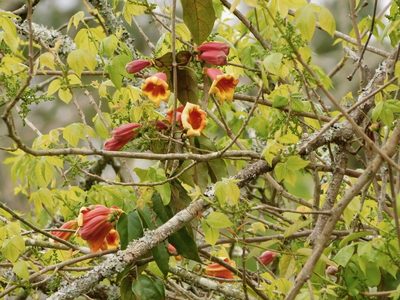
Crossvine
Bignonia capreolata
A vigorous, semi-evergreen climber that smothers a fence in orange-red trumpets each spring.
- Full–part sun
- Dry–average
- 25–50 ft
- Blooms Apr–May
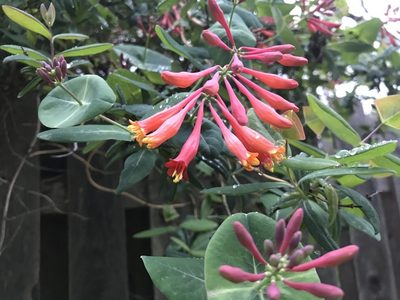
Trumpet Honeysuckle
Lonicera sempervirens
A well-mannered native vine that pours out coral-red hummingbird trumpets from spring to frost.
- Full–part sun
- Dry–average
- 8–15 ft
- Blooms Apr–Sep
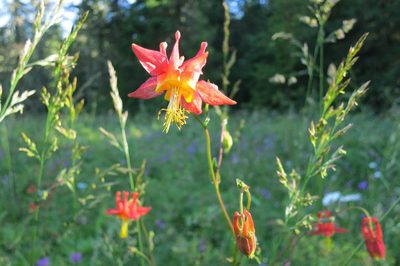
Western Columbine
Aquilegia formosa
The West's nodding red-and-gold columbine, the first big hummingbird draw of the mountain spring.
- Part shade
- Average
- 1.5–3 ft
- Blooms Apr–Jul
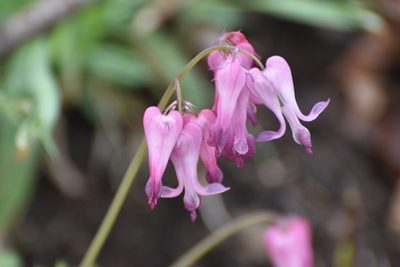
Wild Bleeding Heart
Dicentra eximia
Ferny mounds that drip with pink hearts from spring straight through summer in shade.
- Part shade
- Average
- 12–18 in
- Blooms Apr–Aug
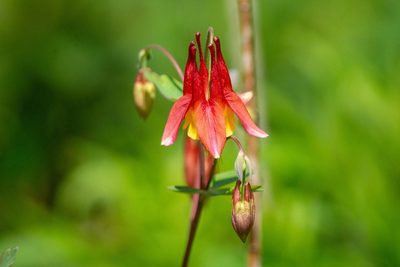
Wild Columbine
Aquilegia canadensis
Nodding red-and-gold lanterns that greet the first spring hummingbirds at a woodland edge.
- Part shade
- Dry–average
- 1–2.5 ft
- Blooms Apr–Jun
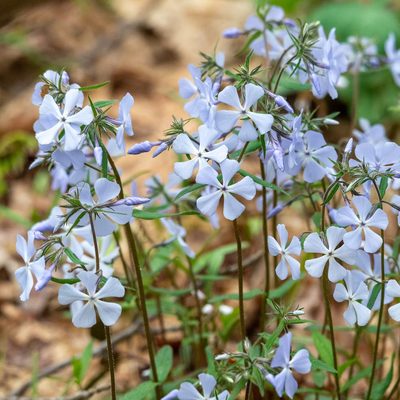
Woodland Phlox
Phlox divaricata
A sweetly fragrant, low spreading phlox that carpets the spring woodland floor in blue.
- Part shade
- Average
- 10–15 in
- Blooms Apr–May
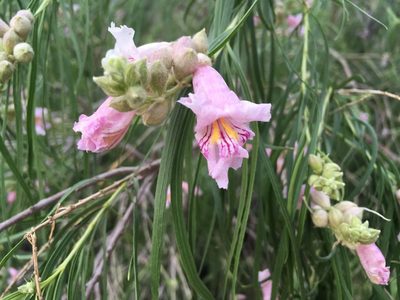
Desert Willow
Chilopsis linearis
A graceful desert tree hung with orchid-like trumpets all summer, fueled by nothing but heat.
- Full sun
- Dry
- 15–25 ft
- Blooms May–Sep
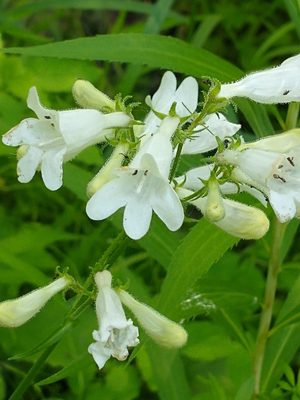
Foxglove Beardtongue
Penstemon digitalis
Airy white bells in early summer, a bridge bloom between spring ephemerals and the summer prairie.
- Full–part sun
- Dry–average
- 2–4 ft
- Blooms May–Jun
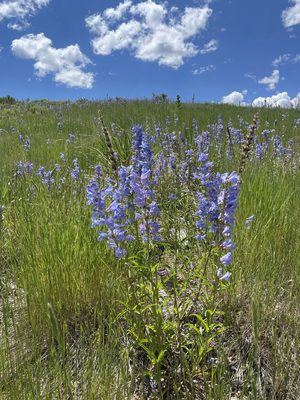
Rocky Mountain Penstemon
Penstemon strictus
Spires of glossy blue tubes built for bumblebees, and one of the easiest western penstemons to grow.
- Full sun
- Dry
- 1.5–2.5 ft
- Blooms May–Jul
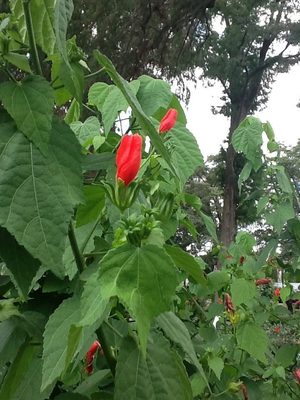
Turk's Cap
Malvaviscus arboreus var. drummondii
One of the few natives that pours out hummingbird-red flowers in dry shade all season long.
- Sun to shade
- Dry–average
- 2–5 ft
- Blooms May–Oct
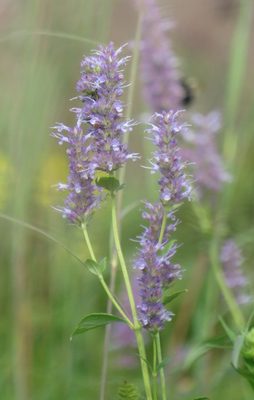
Anise Hyssop
Agastache foeniculum
Months of lavender spikes over licorice-scented foliage, mobbed by bees from dawn to dusk.
- Full–part sun
- Dry–average
- 2–4 ft
- Blooms Jun–Sep

Buttonbush
Cephalanthus occidentalis
Spherical white 'pincushion' flowers over standing water, swarmed by butterflies and bees.
- Full–part sun
- Average–wet
- 5–10 ft
- Blooms Jun–Aug
Flame Acanthus
Anisacanthus quadrifidus var. wrightii
A heat-loving shrub covered in tubular orange flowers through the hottest, driest weeks of summer.
- Full sun
- Dry
- 2–4 ft
- Blooms Jun–Oct

Wild Bergamot
Monarda fistulosa
Ragged lavender crowns that hum with bees, hummingbirds, and clearwing moths; foliage smells of oregano.
- Full–part sun
- Dry–average
- 2–4 ft
- Blooms Jun–Aug
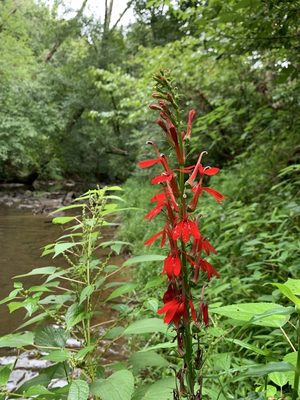
Cardinal Flower
Lobelia cardinalis
The most intense red in the native flora, built for the hummingbirds that pollinate it.
- Full–part sun
- Average–wet
- 2–4 ft
- Blooms Jul–Sep
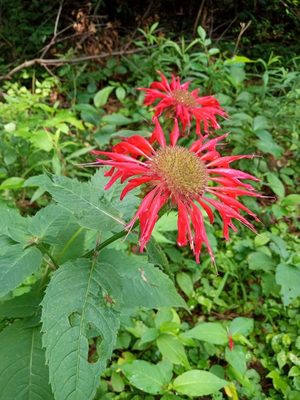
Scarlet Beebalm
Monarda didyma
A hummingbird magnet with fireworks-red blooms for moist, rich soil at a woodland edge.
- Full–part sun
- Average–wet
- 2.5–4 ft
- Blooms Jul–Aug
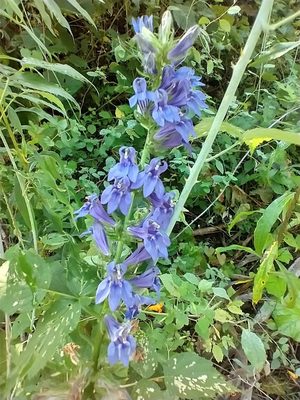
Great Blue Lobelia
Lobelia siphilitica
Spikes of true blue for late summer shade and damp ground, worked hard by bumblebees.
- Full–part sun
- Average–wet
- 2–3 ft
- Blooms Aug–Sep
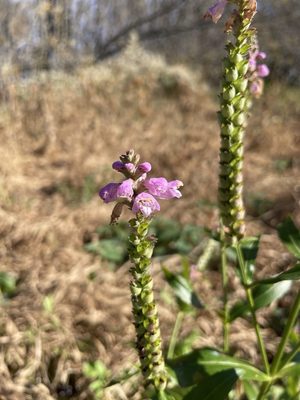
Obedient Plant
Physostegia virginiana
Snapdragon-like pink spikes for late summer, beloved by bumblebees and hummingbirds.
- Full–part sun
- Average–wet
- 2–4 ft
- Blooms Aug–Sep
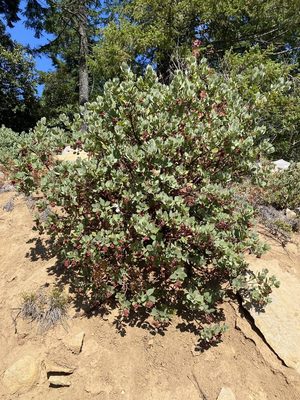
Hairy Manzanita
Arctostaphylos columbiana
Sculptural mahogany bark and early urn-shaped flowers that feed the West Coast's first bees of spring.
- Full–part sun
- Dry
- 3–9 ft
- Blooms Mar–May
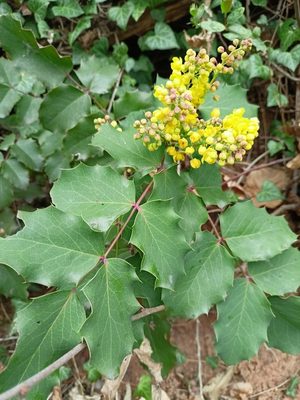
Oregon Grape
Berberis aquifolium
Holly-like evergreen leaves, fragrant yellow spring flowers, and blue berries. It is Oregon's state flower.
- Sun to shade
- Dry–average
- 3–6 ft
- Blooms Mar–Apr
Hummingbirds, near you.
Whether a species belongs in your yard depends on where you garden. These state guides cover it.
Where to find hummingbirds plants
Some links here are affiliate links and we may earn a small commission at no extra cost to you.
What a first-year Hummingbirds planting needs, from a pH kit to mulch.