- Home
- Plant guide
- Oregon Grape
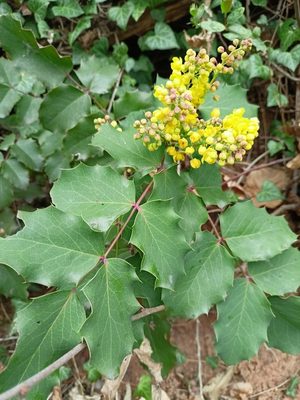
Oregon Grape
Berberis aquifolium
Holly-like evergreen leaves, fragrant yellow spring flowers, and blue berries. It is Oregon's state flower.
Native to: the Pacific Northwest · California · the Mountain West · the Great Basin
Growing Oregon Grape
One of the best native broadleaf evergreens for dry shade in the West. The tart blue 'grapes' feed birds and make a sharp jelly.
Where it belongs
Oregon grape is native to the Pacific Northwest, northern California, the Mountain West, and the Great Basin, growing in the understory of conifer and mixed forest, on rocky slopes, and in open woodland.
Its garden role is a difficult one: evergreen structure in dry shade. The ground under conifers, along a north wall, or beneath established trees is dark and dry and root-filled, and evergreen shrubs that accept it are scarce. This one grew up there.
The berries look like small grapes and are unrelated to them. The genus has been moved between Mahonia and Berberis and you will see both names in catalogs.
Growing it
Part sun to shade, and full sun with enough moisture, dry to medium soil, in loam or rocky ground, zones 5 to 9. Three to six feet tall and three to five feet wide.
Shade suits it and dry shade is where it is most useful. In full sun with dry soil the leaves can bronze and scorch, which some people like and some do not.
It spreads slowly by underground stems into a loose colony, which is how it fills an area under trees.
Leggy old plants can be renewed by cutting the tallest stems to the ground in early spring; new shoots come from the base.
The leaves are spiny like a holly's, which is worth considering next to a path where people brush past.
What it feeds
Dense clusters of bright yellow flowers open in March and April and carry a distinct honey scent.
Native bees work them heavily, and this is early-season forage in a region where early forage is scarce. Bumblebee queens are frequent visitors. Hummingbirds take nectar from the flowers.
The fruit ripens to a dusty blue in summer and is eaten by robins, waxwings, thrushes, juncos, and other birds, and by mammals. Because the shrub is evergreen and dense, it also serves as winter cover and nesting habitat.
Several moths use it as a host plant.
Living with it
Deer generally leave it alone, and the spiny leaves are part of why.
The berries are edible and intensely tart, high in pectin, and are used for jelly and wine. Raw they are sharp enough that most people try one and stop.
A lower-growing relative, creeping Oregon grape, reaches about two feet and works as a groundcover in the same conditions. Choose by the height you need.
There is essentially no maintenance beyond occasional renewal pruning.
Sources: USDA PLANTS Database (native range and nomenclature); Lady Bird Johnson Wildflower Center, University of Texas at Austin (species profile); Oregon State University Extension (culture in dry shade); Xerces Society (early spring bee forage in the Pacific Northwest).
It’s deer-resistant, drought-tolerant, evergreen, and good for winter interest.Where it grows
Oregon Grape is native to the Pacific Northwest. In the wild you’ll find it across Arizona · California · Colorado · Idaho · Montana · Nevada · New Mexico · Oregon · Utah · Washington and 1 more states. Always confirm it suits your specific county with your state native plant society before planting.
Regional Garden has written state guides covering Oregon Grape in 11 of them so far.
Good for
Where to buy Oregon Grape
Some links here are affiliate links and we may earn a small commission at no extra cost to you.
What a first-year Oregon Grape planting needs, from a pH kit to mulch.
Companions & kin.
Natives that share Oregon Grape’s range and conditions.

Golden Currant
Ribes aureum
Yellow spring flowers that smell of cloves, black fruit birds strip in a week, and red foliage in the fall.
- Full–part sun
- Dry–average
- 4–8 ft
- Blooms Apr–May

Blue Elderberry
Sambucus cerulea
Fast, big, and covered in flat cream flower heads, then dusty blue fruit that draws every fruit-eating bird in the county.
- Full–part sun
- Average–wet
- 8–20 ft
- Blooms Jun–Jul
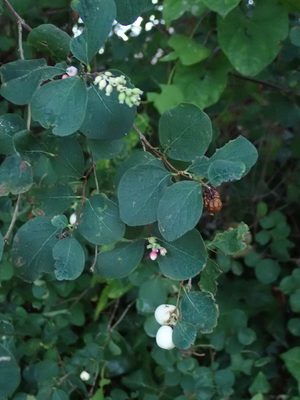
Common Snowberry
Symphoricarpos albus
The shrub that will grow where nothing else will, and hangs white berries on bare stems all winter.
- Sun to shade
- Dry–average
- 3–6 ft
- Blooms Jun–Jul

Saskatoon Serviceberry
Amelanchier alnifolia
White flowers before the leaves, then fruit that tastes like a sweet blueberry, then orange fall color.
- Full–part sun
- Dry–average
- 6–15 ft
- Blooms Apr–May