- Home
- Plant guide
- Common Snowberry
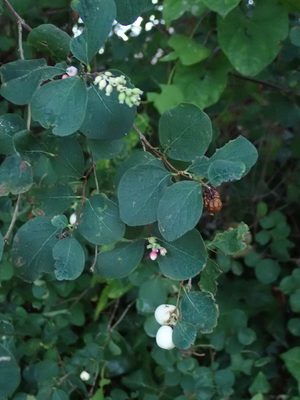
Daniel Cahen (CC BY)
Common Snowberry
Symphoricarpos albus
The shrub that will grow where nothing else will, and hangs white berries on bare stems all winter.
Native to: the Pacific Northwest · the Great Basin · the Mountain West · the Northeast · the Midwest
Growing Common Snowberry
It suckers, which is the point on a bank you want covered and a problem in a small border. The white berries persist into winter and are not for eating.
Where it belongs
Snowberry is one of the most widely distributed shrubs in North America, native from the Pacific Northwest through the Rockies and across the northern tier of the continent. It grows in forest edge, streambank, dry slope and disturbed ground, in full sun and in shade dense enough to stop most other shrubs.
It is a modest plant for most of the year: an arching thicket of thin stems with small blue-green leaves and pink bell flowers so small they are easy to miss. Then the leaves drop and the white berries stay, and the shrub does its most visible work in the dead of winter.
Growing it
There is very little to say, which is the appeal.
It takes sun or deep shade, dry ground or seasonally wet ground, clay, gravel or sand. It tolerates the dry shade under a big conifer, which is the site most gardeners struggle to fill.
It spreads by suckering into a thicket. On a bank you want covered, that is the whole point. In a small border it will need an edge cut around it every year or two, and it is honest to say that a tidy formal bed is not the place for it.
Cut a third of the oldest stems to the ground in late winter if it gets woody and thin. It regrows quickly.
What it feeds
The small flowers are worked steadily by bumblebees and hummingbirds through early summer, and the plant is a larval host for sphinx moths and several other species.
The berries persist because they are not a first-choice food. Robins, waxwings, grouse and quail take them late in winter when better fruit is gone, which is precisely when a food source matters most. They are not for people, and children should be told so.
Living with it
Use it as a thicket rather than a specimen: a bank, a rough edge, an informal hedge, the gap between a fence and a path.
The winter berries are worth siting deliberately. Put the shrub where a window looks at it in January and it earns its space.
It’s deer-resistant, drought-tolerant, easy to grow, good for winter interest, and fast-growing.Where it grows
Common Snowberry is native to the Pacific Northwest. In the wild you’ll find it across Arizona · California · Colorado · Connecticut · Idaho · Illinois · Indiana · Iowa · Kentucky · Maine and 21 more states. Always confirm it suits your specific county with your state native plant society before planting.
Regional Garden has written state guides covering Common Snowberry in 31 of them so far.
Good for
Where to buy Common Snowberry
Some links here are affiliate links and we may earn a small commission at no extra cost to you.
What a first-year Common Snowberry planting needs, from a pH kit to mulch.
Companions & kin.
Natives that share Common Snowberry’s range and conditions.

Golden Currant
Ribes aureum
Yellow spring flowers that smell of cloves, black fruit birds strip in a week, and red foliage in the fall.
- Full–part sun
- Dry–average
- 4–8 ft
- Blooms Apr–May
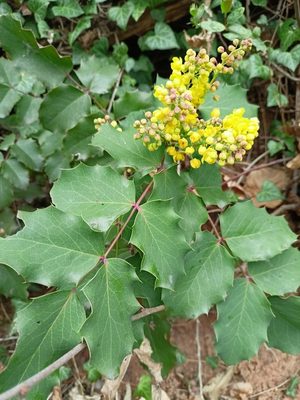
Oregon Grape
Berberis aquifolium
Holly-like evergreen leaves, fragrant yellow spring flowers, and blue berries. It is Oregon's state flower.
- Sun to shade
- Dry–average
- 3–6 ft
- Blooms Mar–Apr
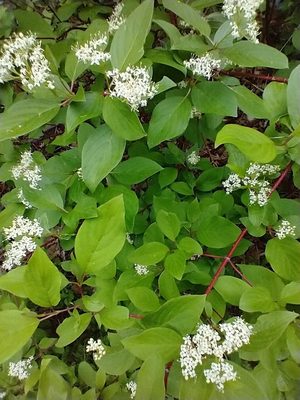
Red-Twig Dogwood
Cornus sericea
Grown for its fire-engine-red winter stems, with white spring flowers and berries birds devour.
- Full–part sun
- Average–wet
- 6–9 ft
- Blooms May–Jun

Saskatoon Serviceberry
Amelanchier alnifolia
White flowers before the leaves, then fruit that tastes like a sweet blueberry, then orange fall color.
- Full–part sun
- Dry–average
- 6–15 ft
- Blooms Apr–May