- Home
- Plant guide
- Firecracker Penstemon
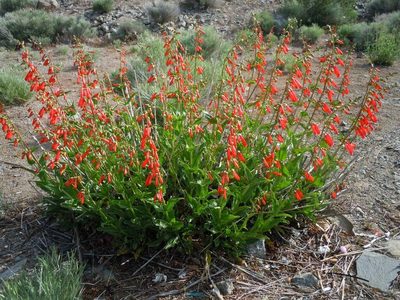
Jim Dreier (CC BY)
Firecracker Penstemon
Penstemon eatonii
Scarlet tubular flowers timed to the spring hummingbird migration through the desert Southwest.
Native to: the desert Southwest · the Great Basin · the Mountain West
Growing Firecracker Penstemon
Wants full sun and gritty, fast-draining soil, never wet feet. Pure hummingbird fuel when little else is open.
Where it belongs
Firecracker penstemon is native to the Southwest, Great Basin, and southern Mountain West, growing on rocky desert slopes, in canyons, on gravelly washes, and in pinyon and juniper country.
Its value is a matter of calendar and geography together. Hummingbirds migrating north through the Southwest in late winter and early spring cross country that has very little in bloom. This plant opens in March, in exactly that country, and it is one of the reliable fuel stops on that route.
Growing it
Full sun, dry soil, in rocky or sandy ground, zones 4 to 9. Eighteen inches to three feet.
Gritty, fast-draining soil and no summer water. Wet feet kill it, and so does kindness generally: this is a plant for the unirrigated part of the yard.
It sends up narrow wands from a low evergreen rosette, and the flowers are held along the upper half. The tubes are narrow and barely flare at the mouth, which is a hummingbird-pollinated shape.
Individual plants are not long-lived, often three to five years. Let it drop seed in the gravel and replacements come along on their own. A planting that is raked and mulched to perfection dies out.
Start from seed with cold stratification, or set out small plants in fall so the roots establish over winter.
What it feeds
Hummingbirds are the point. The color, the tube shape, the lack of a landing platform, and the bloom timing all indicate a bird-pollinated flower, and black-chinned, broad-tailed, and rufous hummingbirds all work it.
In the desert Southwest a March-blooming red tubular flower is worth disproportionately more than the same plant would be in June. Pair it with ocotillo or chuparosa if you have them, and with autumn sage and flame acanthus for the other end of the season.
Bees visit for pollen, though they are not the primary pollinators.
Living with it
Deer generally leave it alone.
Cut spent stems after bloom, but leave the evergreen basal rosette untouched.
This is a plant to buy from a nursery specializing in southwestern natives. Ordinary garden centers in the region often stock hybrid penstemons bred for color, which are less predictable in desert conditions and sometimes less useful to birds.
Sources: USDA PLANTS Database (native range); Lady Bird Johnson Wildflower Center, University of Texas at Austin (species profile); Desert Botanical Garden (southwestern garden culture); Cornell Lab of Ornithology (hummingbird migration routes and spring nectar availability).
It’s deer-resistant, drought-tolerant, and showy.Where it grows
Firecracker Penstemon is native to the desert Southwest. In the wild you’ll find it across Arizona · California · Colorado · Idaho · Montana · Nevada · New Mexico · Oregon · Texas · Utah and 2 more states. Always confirm it suits your specific county with your state native plant society before planting.
Regional Garden has written state guides covering Firecracker Penstemon in 12 of them so far.
Good for
Where to buy Firecracker Penstemon
Some links here are affiliate links and we may earn a small commission at no extra cost to you.
What a first-year Firecracker Penstemon planting needs, from a pH kit to mulch.
Companions & kin.
Natives that share Firecracker Penstemon’s range and conditions.
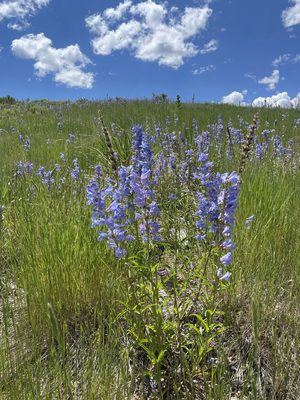
Rocky Mountain Penstemon
Penstemon strictus
Spires of glossy blue tubes built for bumblebees, and one of the easiest western penstemons to grow.
- Full sun
- Dry
- 1.5–2.5 ft
- Blooms May–Jul
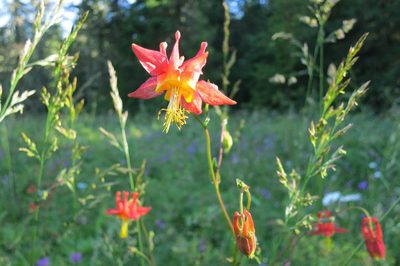
Western Columbine
Aquilegia formosa
The West's nodding red-and-gold columbine, the first big hummingbird draw of the mountain spring.
- Part shade
- Average
- 1.5–3 ft
- Blooms Apr–Jul

Golden Currant
Ribes aureum
Yellow spring flowers that smell of cloves, black fruit birds strip in a week, and red foliage in the fall.
- Full–part sun
- Dry–average
- 4–8 ft
- Blooms Apr–May

Prairie Smoke
Geum triflorum
Nodding pink spring bells that turn into smoky, feathered seed plumes, the show after the flower.
- Full–part sun
- Dry
- 6–16 in
- Blooms Apr–May