- Home
- Plant guide
- Rocky Mountain Penstemon
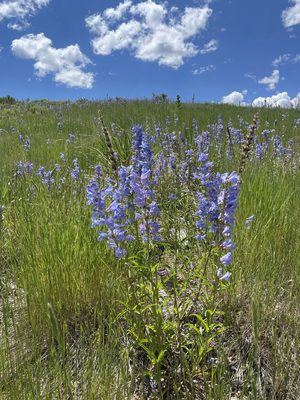
Stephen Hornbeck (CC BY)
Rocky Mountain Penstemon
Penstemon strictus
Spires of glossy blue tubes built for bumblebees, and one of the easiest western penstemons to grow.
Native to: the Mountain West · the Great Basin · the desert Southwest
Growing Rocky Mountain Penstemon
Reliable and long-lived where most penstemons are fussy, as long as drainage is sharp. A staple of the high-desert and mountain garden.
Where it belongs
Rocky Mountain penstemon is native to the Mountain West, Great Basin, and northern Southwest, growing in open pine forest, on sagebrush slopes, and in mountain meadows, generally at elevation.
Penstemon is an enormous western genus, well over two hundred species, and it has a reputation among gardeners for being beautiful and short-lived. Many species are genuinely difficult, wanting precise drainage and disliking any summer water. This one is the exception that gets recommended to beginners: it is long-lived, reliable, and widely available.
Growing it
Full sun, dry soil, in rocky ground, sand, or lean loam, zones 4 to 9. Eighteen inches to two and a half feet.
Sharp drainage matters more than anything else. Clay that stays wet in winter is the usual killer. On a slope, in gravel, or in a raised bed it persists for many years.
Do not fertilize and do not water once established. Extra water shortens its life.
The foliage is a dark glossy evergreen mat that looks good year round, and the flowering stems rise from it in May through July.
It self-sows lightly in gravel, which is welcome, since a few young plants coming along keeps the planting from thinning out.
What it feeds
The flower is a wide tube with a landing lip, and the size and shape are matched to a bumblebee, which walks in and out collecting pollen on its back.
Bumblebees are the primary pollinators and work it constantly through the bloom. Other native bees visit, including penstemon specialists that collect from this genus and few others. Hummingbirds take nectar from it, though the blue-purple color and wide tube suggest bees are the intended visitors.
In the interior West, where summer heat and drought reduce what is in flower, this covers a real gap in late spring and early summer.
Living with it
Deer generally leave it alone.
Cut the spent flowering stems back after bloom for a tidier plant, or leave some standing to shed seed. Leave the basal evergreen mat alone entirely.
For the same conditions in a hotter, lower, drier setting, firecracker penstemon is the species to reach for instead, and it feeds hummingbirds rather than bumblebees.
Sources: USDA PLANTS Database (native range); Lady Bird Johnson Wildflower Center, University of Texas at Austin (species profile); Denver Botanic Gardens and Plant Select (western garden performance and longevity); Xerces Society (penstemon specialist bees).
It’s deer-resistant, drought-tolerant, showy, and easy to grow.Where it grows
Rocky Mountain Penstemon is native to the Mountain West. In the wild you’ll find it across Arizona · California · Colorado · Idaho · Montana · Nevada · New Mexico · Oregon · Texas · Utah and 2 more states. Always confirm it suits your specific county with your state native plant society before planting.
Regional Garden has written state guides covering Rocky Mountain Penstemon in 12 of them so far.
Good for
Where to buy Rocky Mountain Penstemon
Some links here are affiliate links and we may earn a small commission at no extra cost to you.
What a first-year Rocky Mountain Penstemon planting needs, from a pH kit to mulch.
Companions & kin.
Natives that share Rocky Mountain Penstemon’s range and conditions.
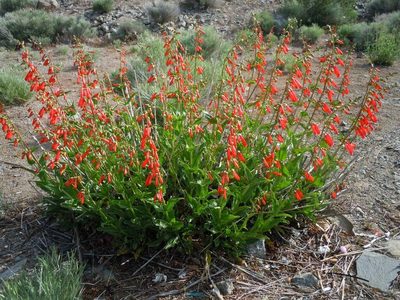
Firecracker Penstemon
Penstemon eatonii
Scarlet tubular flowers timed to the spring hummingbird migration through the desert Southwest.
- Full sun
- Dry
- 1.5–3 ft
- Blooms Mar–May

Prairie Smoke
Geum triflorum
Nodding pink spring bells that turn into smoky, feathered seed plumes, the show after the flower.
- Full–part sun
- Dry
- 6–16 in
- Blooms Apr–May
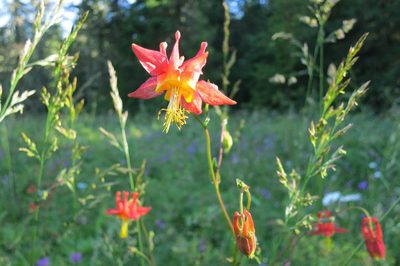
Western Columbine
Aquilegia formosa
The West's nodding red-and-gold columbine, the first big hummingbird draw of the mountain spring.
- Part shade
- Average
- 1.5–3 ft
- Blooms Apr–Jul

Common Yarrow
Achillea millefolium
A near-continental native with flat flower heads that feed tiny beneficial insects, tough as a weed.
- Full sun
- Dry–average
- 1.5–3 ft
- Blooms May–Aug