- Home
- Plant guide
- Wild Columbine
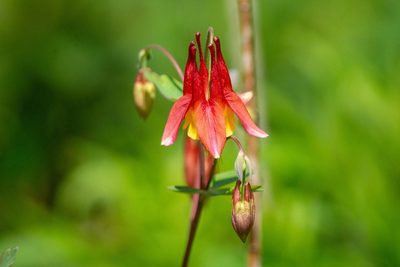
Andrew Lai (CC BY)
Wild Columbine
Aquilegia canadensis
Nodding red-and-gold lanterns that greet the first spring hummingbirds at a woodland edge.
Native to: the Northeast · the Mid-Atlantic · the Southeast · the Midwest · the Great Plains
Growing Wild Columbine
Thrives in dry shade and rocky ledges where little else will. Self-sows gently; let a few seedlings stand to keep the colony going.
Where it belongs
Wild columbine grows across the East and Midwest and out into the Plains, on rocky slopes, ledges, cliff bases, and the thin soil of open woods. It is a plant of places with more stone than dirt.
That preference is the useful part. Dry shade is the hardest condition in most yards: under a maple, along a north foundation, at the top of a shaded bank where water sheds off. Very little flowers there. This does.
Growing it
Part sun to shade, dry to medium soil, in loam or rocky ground, zones 3 to 8. One to two and a half feet, and airy rather than bulky.
Drainage is the requirement. It will grow in a crack in a stone wall and die in a rich, wet bed. If you are planting on level ground, work in grit rather than compost.
Individual plants are not long-lived, often three or four years, and the colony persists by seed instead. That changes what good care looks like. Let some seed capsules ripen and shed, and do not mulch so heavily that seedlings cannot find bare soil. A columbine planting that is weeded and mulched to perfection quietly disappears.
It hybridizes readily with garden columbines. If you want the native form to stay itself, do not plant hybrids next to it.
What it feeds
The flower hangs upside down with five long red spurs, and nectar sits at the tip of each spur. That is a hummingbird's shape, and the bloom period lines up with ruby-throats arriving in the North before much else is open.
Long-tongued bumblebees reach the nectar. Short-tongued bees often cannot, and chew a hole at the base of the spur to steal it, which is worth watching for. Hawk moths visit at dusk. A specialist bee, the columbine miner bee, collects pollen from this genus and little else.
Living with it
Deer generally pass it by.
Columbine leaf miners tunnel pale squiggles through the foliage most years. It looks alarming and does essentially nothing to the plant. Cutting the affected leaves off in midsummer produces fresh growth if the appearance bothers you.
The foliage stays attractive after bloom, blue-green and clover-like, so it holds its spot in a shade planting all season.
Sources: USDA PLANTS Database (native range); Lady Bird Johnson Wildflower Center, University of Texas at Austin (species profile and pollination); Cornell Lab of Ornithology (spring hummingbird arrival and plantings).
It’s deer-resistant, easy to grow, and showy.Where it grows
Wild Columbine is native to the Northeast. In the wild you’ll find it across Alabama · Arkansas · Colorado · Connecticut · Delaware · Florida · Georgia · Illinois · Indiana · Iowa and 32 more states. Always confirm it suits your specific county with your state native plant society before planting.
Regional Garden has written state guides covering Wild Columbine in 42 of them so far.
Good for
Where to buy Wild Columbine
Some links here are affiliate links and we may earn a small commission at no extra cost to you.
What a first-year Wild Columbine planting needs, from a pH kit to mulch.
Companions & kin.
Natives that share Wild Columbine’s range and conditions.
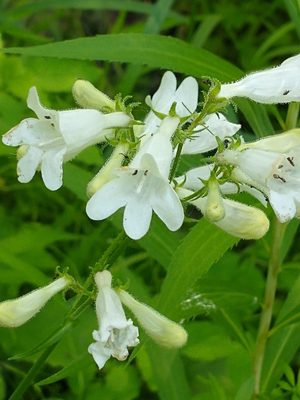
Foxglove Beardtongue
Penstemon digitalis
Airy white bells in early summer, a bridge bloom between spring ephemerals and the summer prairie.
- Full–part sun
- Dry–average
- 2–4 ft
- Blooms May–Jun
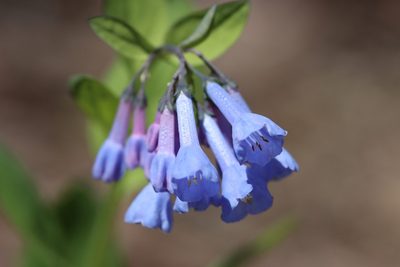
Virginia Bluebells
Mertensia virginica
Pink buds opening to drifts of sky-blue bells, then vanishing underground by summer.
- Part shade
- Average–wet
- 1–2 ft
- Blooms Mar–May
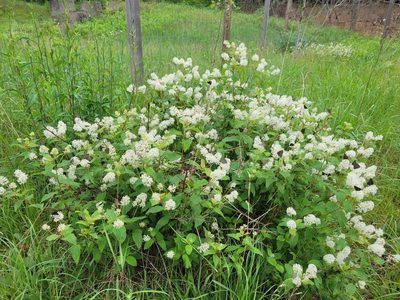
New Jersey Tea
Ceanothus americanus
A compact, drought-proof shrub frothing with white flowers that pollinators and hummingbirds adore.
- Full–part sun
- Dry
- 2–3.5 ft
- Blooms May–Jul

Wild Bergamot
Monarda fistulosa
Ragged lavender crowns that hum with bees, hummingbirds, and clearwing moths; foliage smells of oregano.
- Full–part sun
- Dry–average
- 2–4 ft
- Blooms Jun–Aug