- Home
- Plant guide
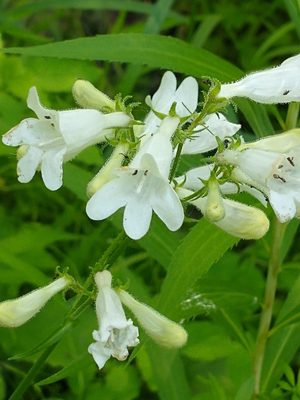
- Foxglove Beardtongue
Tom Norton (CC BY)
Foxglove Beardtongue
Penstemon digitalis
Airy white bells in early summer, a bridge bloom between spring ephemerals and the summer prairie.
Native to: the Northeast · the Mid-Atlantic · the Southeast · the Midwest · the Great Plains
Growing Foxglove Beardtongue
Unfussy in heavy clay and a great clay-buster. 'Husker Red' and wild forms both feed early-season bees heavily.
Where it belongs
Foxglove beardtongue is native across the East, Midwest, and eastern Plains, growing in prairies, old fields, open woods, and roadside ditches. It is common enough that most people have driven past it without registering it.
Its calendar slot is what makes it valuable. Spring ephemerals are finished by late May. The prairie perennials do not start until July. Early June is a real gap in most native plantings, and this fills it, along with golden alexanders and wild lupine.
Growing it
Full sun to part sun, dry to medium soil, in clay, loam, or rocky ground, zones 3 to 8. Two to four feet.
Clay is the headline. Most drought-tolerant perennials want sand or grit, and gardeners on heavy soil are told repeatedly to amend it. This plant grows in unamended clay and keeps growing there, and its deep fibrous roots open the soil as they go.
It is easy from seed after cold-moist stratification and often blooms in its second year. It self-sows moderately in open ground.
The foliage is a low rosette that stays neat all season, so the plant does not leave a hole after flowering the way some early perennials do. Selections with maroon foliage are widely sold; the straight species is green, and both feed insects.
What it feeds
The flower is a white tube wide enough for a bumblebee to walk into, and that is mostly what happens. Bumblebees are the primary pollinators, and this is one of the important early-season plants for queens that founded colonies in spring and have brood to feed.
Small carpenter bees and mason bees work it too. Hummingbirds visit. A group of specialist bees collects pollen from penstemons specifically.
The name comes from the fifth stamen, which is sterile and bearded with fine hairs. It is visible with a hand lens and is a small pleasure once you know to look.
Living with it
Deer resistant, drought tolerant once established, and free of the diseases that trouble showier perennials.
In very rich soil the flowering stems can lean after a hard rain. That is a reason to plant it in ordinary ground rather than improving the ground for it.
Seed capsules dry to a tan structure that stands through winter and looks deliberate. Cut back in spring.
Sources: USDA PLANTS Database (native range); Lady Bird Johnson Wildflower Center, University of Texas at Austin (species profile); Xerces Society (bumblebee and specialist bee forage).
It’s deer-resistant, drought-tolerant, easy to grow, and showy.Where it grows
Foxglove Beardtongue is native to the Northeast. In the wild you’ll find it across Alabama · Arkansas · Colorado · Connecticut · Delaware · Florida · Georgia · Illinois · Indiana · Iowa and 32 more states. Always confirm it suits your specific county with your state native plant society before planting.
Regional Garden has written state guides covering Foxglove Beardtongue in 42 of them so far.
Good for
Where to buy Foxglove Beardtongue
Some links here are affiliate links and we may earn a small commission at no extra cost to you.
What a first-year Foxglove Beardtongue planting needs, from a pH kit to mulch.
Companions & kin.
Natives that share Foxglove Beardtongue’s range and conditions.
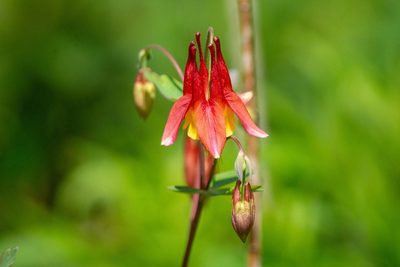
Wild Columbine
Aquilegia canadensis
Nodding red-and-gold lanterns that greet the first spring hummingbirds at a woodland edge.
- Part shade
- Dry–average
- 1–2.5 ft
- Blooms Apr–Jun
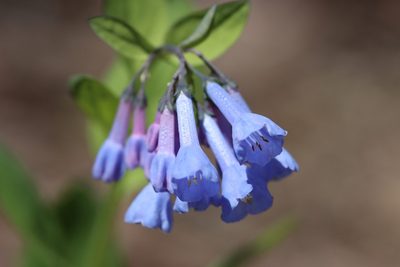
Virginia Bluebells
Mertensia virginica
Pink buds opening to drifts of sky-blue bells, then vanishing underground by summer.
- Part shade
- Average–wet
- 1–2 ft
- Blooms Mar–May
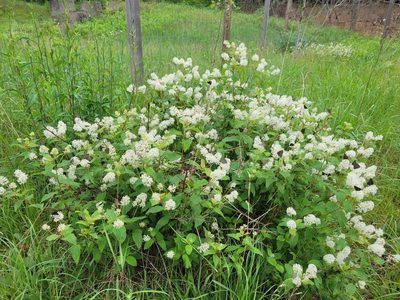
New Jersey Tea
Ceanothus americanus
A compact, drought-proof shrub frothing with white flowers that pollinators and hummingbirds adore.
- Full–part sun
- Dry
- 2–3.5 ft
- Blooms May–Jul

Wild Bergamot
Monarda fistulosa
Ragged lavender crowns that hum with bees, hummingbirds, and clearwing moths; foliage smells of oregano.
- Full–part sun
- Dry–average
- 2–4 ft
- Blooms Jun–Aug