- Home
- Plant guide
- Woodland Phlox
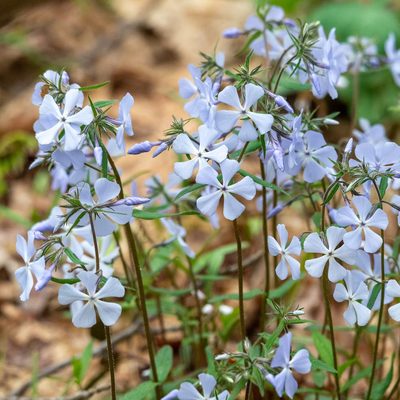
Patrick Hanly (CC BY)
Woodland Phlox
Phlox divaricata
A sweetly fragrant, low spreading phlox that carpets the spring woodland floor in blue.
Native to: the Northeast · the Mid-Atlantic · the Southeast · the Midwest
Growing Woodland Phlox
Spreads slowly by creeping stems into a loose groundcover. Among the few natives that draw spring butterflies into shade.
Where it belongs
Woodland phlox, also called wild blue phlox, is native to the Northeast, Mid-Atlantic, Southeast, and Midwest, growing in open deciduous woods, along shaded stream banks, and at the edges of woodland clearings.
It is often confused with creeping phlox, the mat-forming species that covers sunny rock walls in April. They are different plants for different places. Creeping phlox is an evergreen mat for full sun and dry rock; this one is a loose, upright, deciduous phlox for shade and woodland soil.
Growing it
Part sun to shade, medium moisture, in loam, zones 3 to 8. Ten to fifteen inches in bloom.
Woodland conditions: leaf litter, dappled light, soil that stays cool and does not bake. It is fine under deciduous trees, where it gets full spring light before the canopy closes and shade for the rest of the year.
It spreads by creeping stems that root where they touch the ground, so a single plant becomes a loose drift over several years. This is a gentle spread rather than an invasion, and it does not smother neighbors.
Unlike the ephemerals it stays green through summer, though the foliage is low and unremarkable after bloom. It can develop powdery mildew in a crowded, still spot late in the season.
What it feeds
The flower is a long narrow tube with a flat five-lobed face, and the combination is a butterfly's shape: something to land on and a tube only a long tongue can drain.
That matters because most shade plants feed bees and little else. Spring azures, swallowtails, and early skippers visit woodland phlox, and it is one of very few opportunities for butterflies in a shaded yard in April and May. Hummingbirds work it. Sphinx moths visit at dusk, and the scent is strongest then.
Long-tongued bumblebees can reach the nectar; shorter-tongued bees generally cannot and collect pollen instead.
Living with it
Deer and rabbits will browse it, and in high-pressure areas it needs protection to establish.
The fragrance is real and worth siting for. Plant it along a path or near a door rather than at the back of a bed, since the scent is light and carries only a short distance.
It combines naturally with Virginia bluebells, wild geranium, and foamflower, all of which want the same conditions and overlap in bloom.
Leave the foliage in place over winter under the leaf litter.
Sources: USDA PLANTS Database (native range); Lady Bird Johnson Wildflower Center, University of Texas at Austin (species profile and pollination); Mt. Cuba Center (Phlox trial observations on garden performance).
It’s fragrant, and showy.Where it grows
Woodland Phlox is native to the Northeast. In the wild you’ll find it across Alabama · Arkansas · Connecticut · Delaware · Florida · Georgia · Illinois · Indiana · Iowa · Kentucky and 24 more states. Always confirm it suits your specific county with your state native plant society before planting.
Regional Garden has written state guides covering Woodland Phlox in 34 of them so far.
Good for
Where to buy Woodland Phlox
Some links here are affiliate links and we may earn a small commission at no extra cost to you.
What a first-year Woodland Phlox planting needs, from a pH kit to mulch.
Companions & kin.
Natives that share Woodland Phlox’s range and conditions.
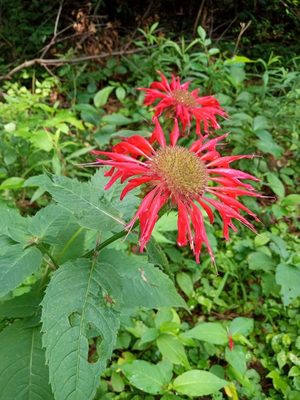
Scarlet Beebalm
Monarda didyma
A hummingbird magnet with fireworks-red blooms for moist, rich soil at a woodland edge.
- Full–part sun
- Average–wet
- 2.5–4 ft
- Blooms Jul–Aug

Wild Bergamot
Monarda fistulosa
Ragged lavender crowns that hum with bees, hummingbirds, and clearwing moths; foliage smells of oregano.
- Full–part sun
- Dry–average
- 2–4 ft
- Blooms Jun–Aug
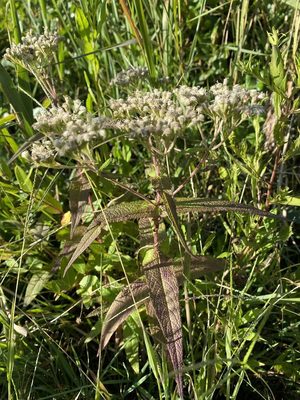
Common Boneset
Eupatorium perfoliatum
Frothy white heads alive with small native bees and wasps, for ground that stays damp.
- Full–part sun
- Average–wet
- 3–5 ft
- Blooms Aug–Sep
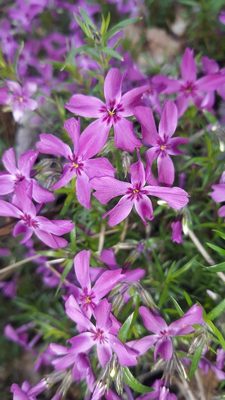
Creeping Phlox
Phlox subulata
A sheet of spring color that spills over walls and stitches a dry, sunny slope together.
- Full–part sun
- Dry–average
- 4–8 in
- Blooms Apr–May