- Home
- Plant guide
- Trumpet Honeysuckle
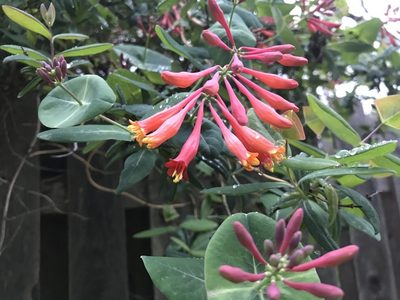
Luke Padon (CC BY)
Trumpet Honeysuckle
Lonicera sempervirens
A well-mannered native vine that pours out coral-red hummingbird trumpets from spring to frost.
Native to: the Northeast · the Mid-Atlantic · the Southeast · the Midwest · the South-Central region
Growing Trumpet Honeysuckle
The native alternative to invasive Japanese honeysuckle: vigorous but never thuggish. Train it on a trellis, fence, or mailbox post for nonstop hummingbird traffic.
Where it belongs
Trumpet honeysuckle, also called coral honeysuckle, is native to the East, Mid-Atlantic, Southeast, Midwest, and Texas, growing at woodland edges, in thickets, and along fencerows.
Its most useful quality is what it is not. Japanese honeysuckle, the fragrant white and yellow vine that smothers roadsides across the East, is invasive and pulls down the plants it climbs. This is a native alternative with the same climbing habit, brighter flowers, a longer season, and none of the aggression.
The flowers have no scent, which is the one thing people miss when they switch.
Growing it
Full sun to part sun, dry to medium soil, in loam or clay, zones 4 to 9. Eight to fifteen feet.
Undemanding. It takes ordinary soil, tolerates drought once established, and flowers most heavily in sun.
It is a twining vine, so it needs something thin to wrap around: a trellis, a wire, a fence, a lamppost, a mailbox. It will not climb a flat wall by itself, and it has no adhesive pads, so it does not damage siding or masonry.
It is well-behaved to the point where the complaint is usually the opposite of smothering: it can look sparse and thin for the first couple of years. Cut it back hard in late winter to encourage branching from the base.
It is semi-evergreen in the South and deciduous in the North.
What it feeds
The flowers are narrow coral-red tubes with yellow-orange throats, held in whorled clusters at the stem tips, and hummingbirds work them constantly. In the eastern half of the country this is one of the top two or three hummingbird plants available, and the reason is the bloom season: heaviest in spring, then recurring through summer and into fall, so it covers migration and breeding both.
Butterflies take nectar. It hosts the spring azure and the snowberry clearwing, a day-flying moth that looks and behaves like a small hummingbird.
Red berries follow the flowers and are eaten by robins, catbirds, goldfinches, and quail.
Living with it
Deer will browse it where pressure is high.
Aphids arrive on new growth most years and are a nuisance rather than a threat. Spraying a vine grown for hummingbirds defeats the purpose. Ladybird beetles usually resolve it.
Cut back and thin in late winter. Deadheading spent clusters through the season encourages the repeat bloom, which is what makes this vine worth its space.
Sources: USDA PLANTS Database (native range); Lady Bird Johnson Wildflower Center, University of Texas at Austin (species profile); Cornell Lab of Ornithology (hummingbird garden plants); Mt. Cuba Center (Lonicera sempervirens trial results on bloom period and cultivar performance).
It’s showy, long-blooming, and easy to grow.Where it grows
Trumpet Honeysuckle is native to the Northeast. In the wild you’ll find it across Alabama · Arkansas · Connecticut · Delaware · Florida · Georgia · Illinois · Indiana · Iowa · Kentucky and 24 more states. Always confirm it suits your specific county with your state native plant society before planting.
Regional Garden has written state guides covering Trumpet Honeysuckle in 34 of them so far.
Good for
Where to buy Trumpet Honeysuckle
Some links here are affiliate links and we may earn a small commission at no extra cost to you.
What a first-year Trumpet Honeysuckle planting needs, from a pH kit to mulch.
Companions & kin.
Natives that share Trumpet Honeysuckle’s range and conditions.

Buttonbush
Cephalanthus occidentalis
Spherical white 'pincushion' flowers over standing water, swarmed by butterflies and bees.
- Full–part sun
- Average–wet
- 5–10 ft
- Blooms Jun–Aug
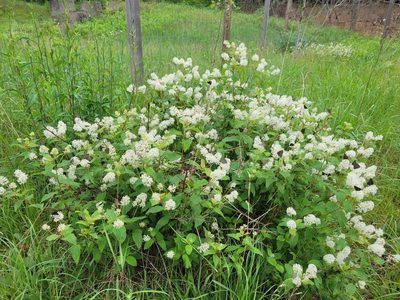
New Jersey Tea
Ceanothus americanus
A compact, drought-proof shrub frothing with white flowers that pollinators and hummingbirds adore.
- Full–part sun
- Dry
- 2–3.5 ft
- Blooms May–Jul
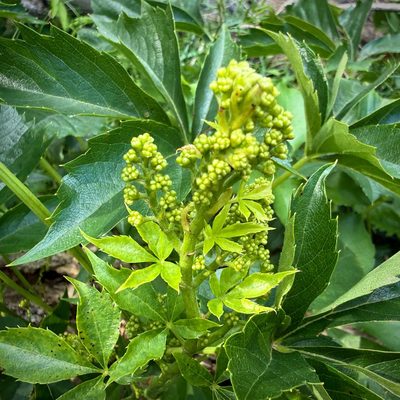
Virginia Creeper
Parthenocissus quinquefolia
A tough native climber grown for spectacular scarlet fall color and berries that 35+ bird species eat.
- Sun to shade
- Dry–average
- 30–50 ft
- Blooms Jun
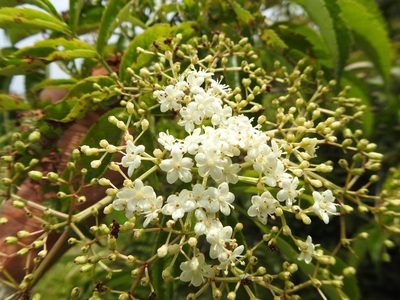
American Elderberry
Sambucus canadensis
Big lacy flower heads in summer give way to purple-black berries for both birds and your kitchen.
- Full–part sun
- Average–wet
- 6–12 ft
- Blooms Jun–Jul