- Home
- Plant guide
- Desert Willow
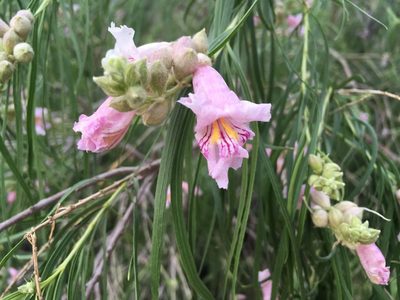
W. Terry Hunefeld (CC BY)
Desert Willow
Chilopsis linearis
A graceful desert tree hung with orchid-like trumpets all summer, fueled by nothing but heat.
Native to: the desert Southwest
Growing Desert Willow
Not a true willow, but a fast, airy small tree for hot, dry yards needing summer shade. Drops its seed pods, so site it away from patios.
Where it belongs
Desert willow is native to the Southwest, from west Texas across New Mexico, Arizona, and into southern California, growing along desert washes and intermittent streams where runoff collects after storms.
That habitat explains its behavior. It is a plant of dry country that grows where water occasionally passes through, so it is deeply drought tolerant but also fast-growing when water is available.
The name comes from the narrow leaves, which look like a willow's. It is not related to willows at all; it is in the trumpet-creeper family, alongside catalpa and trumpet vine, which the flowers make obvious.
Growing it
Full sun, dry soil, in sand, rocky ground, or loam, zones 7 to 9. Fifteen to twenty-five feet tall and ten to twenty feet wide.
Sun and drainage. It grows fast for a desert tree, several feet a year when young, and it will accept occasional deep watering that speeds it further. Overwatering produces weak growth and reduces flowering.
It is deciduous and leafs out late, so it looks bare well into spring. That is normal.
The natural habit is multi-trunked and open, casting light dappled shade rather than heavy shade, which suits a desert yard where full shade would kill the plants beneath it. It can be trained to a single trunk if you prefer.
Prune in winter to shape it and to lift the canopy. It drops long seed pods, which is worth thinking about before planting it over a patio or a pool.
What it feeds
The flowers are large ruffled trumpets in shades of pink, lavender, and white with yellow throats, held in clusters at the branch tips from May into September.
Hummingbirds work them heavily. So do large bees, particularly carpenter bees, which are heavy enough to force their way into the throat, and they are the main pollinators.
The seed pods are long and thin, splitting to release winged seeds. Small birds take them, and the tree provides nesting cover and perching in landscapes with few trees, which is a large part of its habitat value in the desert.
Living with it
Deer generally leave it alone once it is past sapling height.
Many named selections exist, chosen for flower color and for reduced seed pod production, and Bubba and Warren Jones are among the widely sold ones.
It is a good candidate for the west or south side of a house, where its summer shade lowers cooling load and its winter bareness lets the sun through.
Sources: USDA PLANTS Database (native range); Lady Bird Johnson Wildflower Center, University of Texas at Austin (species profile); Desert Botanical Garden and Arizona Cooperative Extension (desert tree culture and water use).
It’s deer-resistant, drought-tolerant, showy, and long-blooming.Where it grows
Desert Willow is native to the desert Southwest. In the wild you’ll find it across Arizona · California · Nevada · New Mexico · Texas · Utah. Always confirm it suits your specific county with your state native plant society before planting.
Regional Garden has written state guides covering Desert Willow in 6 of them so far.
Good for
Where to buy Desert Willow
Some links here are affiliate links and we may earn a small commission at no extra cost to you.
What a first-year Desert Willow planting needs, from a pH kit to mulch.
Companions & kin.
Natives that share Desert Willow’s range and conditions.
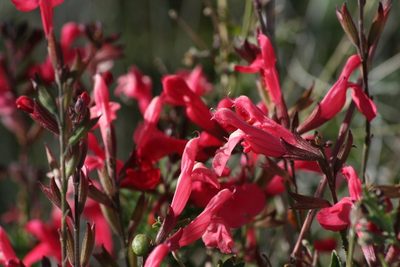
Autumn Sage
Salvia greggii
A tough little evergreen sage that feeds hummingbirds from spring to frost in Texas and the Southwest.
- Full–part sun
- Dry
- 2–3 ft
- Blooms Apr–Oct
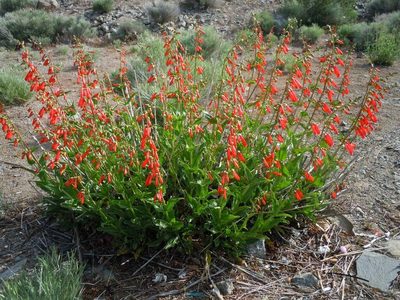
Firecracker Penstemon
Penstemon eatonii
Scarlet tubular flowers timed to the spring hummingbird migration through the desert Southwest.
- Full sun
- Dry
- 1.5–3 ft
- Blooms Mar–May

Golden Currant
Ribes aureum
Yellow spring flowers that smell of cloves, black fruit birds strip in a week, and red foliage in the fall.
- Full–part sun
- Dry–average
- 4–8 ft
- Blooms Apr–May
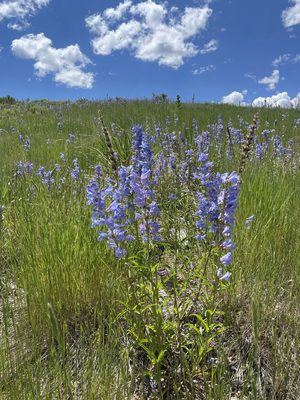
Rocky Mountain Penstemon
Penstemon strictus
Spires of glossy blue tubes built for bumblebees, and one of the easiest western penstemons to grow.
- Full sun
- Dry
- 1.5–2.5 ft
- Blooms May–Jul