- Home
- Plant guide
- Lewis's Mock Orange
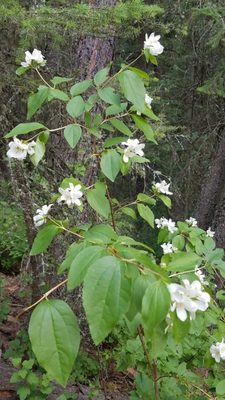
Charles Swift (CC BY)
Lewis's Mock Orange
Philadelphus lewisii
Two weeks in early summer when the whole shrub smells of orange blossom, and the rest of the year asking for nothing.
Native to: the Pacific Northwest · the Mountain West
Growing Lewis's Mock Orange
Idaho's state flower, and one of the few Western natives grown purely for scent. Prune right after flowering; it blooms on old wood, so a spring cut removes the whole show.
Where it belongs
Mock orange grows on rocky slopes, canyon walls, streambanks and open woodland from British Columbia south through the interior Northwest and into the northern Rockies. It is Idaho's state flower.
Meriwether Lewis collected it in 1806, which is where the species name comes from. It is one of very few Western natives grown primarily for scent rather than for looks, structure or wildlife value, though it happens to offer those too.
Growing it
It is a loose, upright shrub, five to ten feet tall, with arching stems and plain green leaves. For two or three weeks in late spring and early summer it carries four-petaled white flowers in clusters along the previous year's growth, and the scent carries across a yard on a warm evening.
Full sun gives the heaviest bloom. Part shade is fine and produces a looser, taller plant. It takes ordinary garden soil, rocky ground, or a dry slope, and once established it does not need summer water in most of its range.
The one thing that will cost you the flowers is pruning at the wrong time. It blooms on wood grown the previous year, so a tidy-up in early spring removes the entire display. Prune immediately after flowering, and only to take out the oldest stems at the base.
What it feeds
The open flowers are easy for a wide range of insects to reach, and bumblebees, solitary bees, syrphid flies and butterflies all work them. It is a nectar plant rather than a host plant for most of the season.
Birds use the dense arching structure for nesting more than they use it for food, which is a fair trade in a shrub this size.
Living with it
Site it by a door, a path, a window that opens, or wherever people sit in June. The scent is the reason to grow it and it is wasted at the back of a property.
Out of bloom it is an unremarkable green shrub, so it works best with something in front of it rather than alone in the middle of a lawn.
It’s fragrant, drought-tolerant, deer-resistant, showy, and easy to grow.Where it grows
Lewis's Mock Orange is native to the Pacific Northwest. In the wild you’ll find it across Arizona · California · Colorado · Idaho · Montana · New Mexico · Oregon · Utah · Washington · Wyoming. Always confirm it suits your specific county with your state native plant society before planting.
Regional Garden has written state guides covering Lewis's Mock Orange in 10 of them so far.
Good for
Where to buy Lewis's Mock Orange
Some links here are affiliate links and we may earn a small commission at no extra cost to you.
What a first-year Lewis's Mock Orange planting needs, from a pH kit to mulch.
Companions & kin.
Natives that share Lewis's Mock Orange’s range and conditions.

Blue Elderberry
Sambucus cerulea
Fast, big, and covered in flat cream flower heads, then dusty blue fruit that draws every fruit-eating bird in the county.
- Full–part sun
- Average–wet
- 8–20 ft
- Blooms Jun–Jul

Golden Currant
Ribes aureum
Yellow spring flowers that smell of cloves, black fruit birds strip in a week, and red foliage in the fall.
- Full–part sun
- Dry–average
- 4–8 ft
- Blooms Apr–May
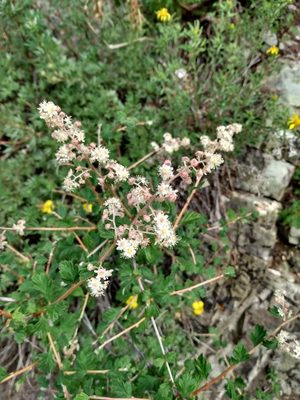
Oceanspray
Holodiscus discolor
Foaming cream plumes in midsummer that dry to tan and stand all winter, on a shrub that takes sun or shade and no water.
- Sun to shade
- Dry–average
- 6–12 ft
- Blooms Jun–Jul

Saskatoon Serviceberry
Amelanchier alnifolia
White flowers before the leaves, then fruit that tastes like a sweet blueberry, then orange fall color.
- Full–part sun
- Dry–average
- 6–15 ft
- Blooms Apr–May