- Home
- Plant guide
- Purple Coneflower
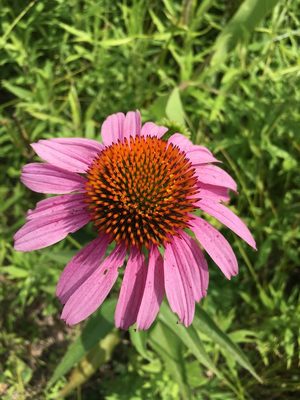
Purple Coneflower
Echinacea purpurea
The garden workhorse: months of nectar for bees and butterflies, then seed heads goldfinches strip all winter.
Native to: the Midwest · the Southeast · the Mid-Atlantic · the Great Plains · the Northeast
Growing Purple Coneflower
Tough, long-lived, and forgiving of clay and drought once established. Leave the spent cones standing through winter for the birds and for next year's self-sown seedlings.
Where it belongs
Purple coneflower is native to the eastern and central United States, from the prairie edge through the oak savanna and into open woodland. That origin is the useful fact about it: it evolved in full sun on ground that dries out, not in a tended border, and it behaves best when treated accordingly.
It is hardy across an unusually wide range, which is why it turns up in gardens from Minnesota to Georgia. Being widely adaptable is not the same as being locally native, though. Check whether it belongs in your county rather than assuming, because in parts of the West it is a garden plant rather than part of the local flora.
Growing it
Give it sun. Six hours minimum, and more is better. In shade it stretches, flops, and flowers thinly.
Soil matters less than drainage. It tolerates clay, which is unusual among prairie perennials and a large part of its value in the Midwest and the Piedmont, but it will rot in ground that stays saturated through winter. On heavy soil, plant on a slight rise rather than in a hollow.
Do not feed it. Rich soil produces tall soft growth that falls over by July, and that flopping is almost always a fertility problem rather than a staking problem. Lean ground gives shorter, sturdier plants that hold themselves up.
Water through the first season while the taproot goes down, then stop. An established plant handles drought without help.
What it feeds
The flowers are open and flat, which makes them usable by a wide range of insects rather than only long-tongued specialists. Bees work them heavily through summer, and butterflies use them as landing platforms in a way they cannot use tubular flowers.
The seed heads are the part most gardeners cut off and should not. Goldfinches strip them through autumn and into winter, and the standing stems shelter overwintering insects. Cutting the plant back in October removes months of wildlife value for the sake of tidiness nobody is looking at.
Living with it
It is short-lived by perennial standards, often three to five years, and it persists by self-sowing rather than by individual plants lasting. Leave some seed heads and it maintains its own patch. Deadhead everything and the planting thins out and disappears, which is the usual reason someone concludes it did not work for them.
Seedlings vary. That variation is the plant behaving normally, and it is why seed-grown plants tend to outlast the identical cultivars sold in flower.
Sources: USDA PLANTS Database (native status and range); Lady Bird Johnson Wildflower Center, University of Texas at Austin (species profile and cultural requirements); Mt. Cuba Center (Echinacea trial results on garden performance).
It’s deer-resistant, drought-tolerant, easy to grow, showy, long-blooming, and a good cut flower.Where it grows
Purple Coneflower is native to the Midwest. In the wild you’ll find it across Alabama · Arkansas · Colorado · Connecticut · Delaware · Florida · Georgia · Illinois · Indiana · Iowa and 32 more states. Always confirm it suits your specific county with your state native plant society before planting.
Regional Garden has written state guides covering Purple Coneflower in 42 of them so far.
Good for
Where to buy Purple Coneflower
Some links here are affiliate links and we may earn a small commission at no extra cost to you.
What a first-year Purple Coneflower planting needs, from a pH kit to mulch.
Companions & kin.
Natives that share Purple Coneflower’s range and conditions.
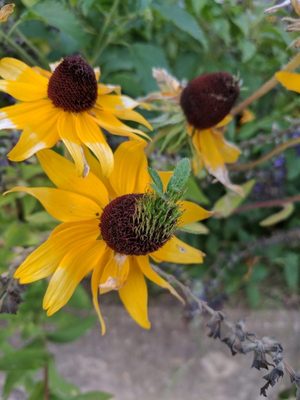
Black-Eyed Susan
Rudbeckia hirta
A cheerful, unkillable starter native that blooms its first year and seeds itself politely around.
- Full–part sun
- Dry–average
- 1.5–3 ft
- Blooms Jun–Sep
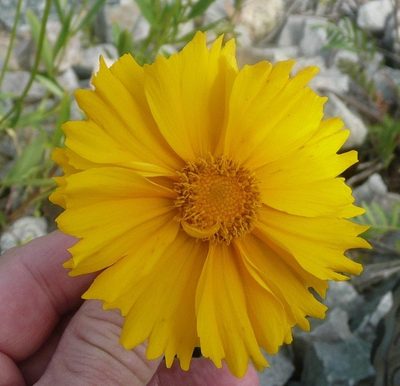
Lanceleaf Coreopsis
Coreopsis lanceolata
Sunny gold daisies for weeks in early summer on the leanest, driest soil you can offer.
- Full sun
- Dry–average
- 1.5–2 ft
- Blooms May–Jul
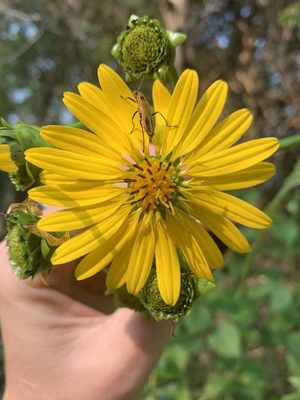
Cup Plant
Silphium perfoliatum
A prairie giant whose paired leaves hold rainwater for birds; goldfinches mob the seeds.
- Full–part sun
- Average–wet
- 5–8 ft
- Blooms Jul–Sep
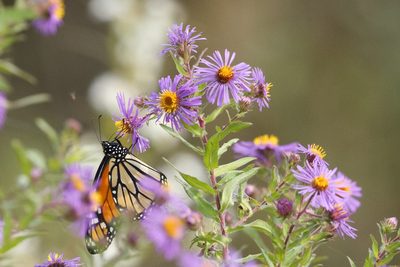
New England Aster
Symphyotrichum novae-angliae
Late-season fuel: clouds of purple daisies feeding migrating monarchs and the last bumblebees of fall.
- Full–part sun
- Average–wet
- 3–5 ft
- Blooms Sep–Oct