- Home
- Plant guide
- Spicebush
Spicebush
Lindera benzoin
An early-blooming shade shrub, host to the spicebush swallowtail, with butter-yellow fall color.
Native to: the Northeast · the Mid-Atlantic · the Southeast · the Midwest
Growing Spicebush
One of the best native shrubs for shade and the host plant of its namesake swallowtail. Red fall berries on female plants are prized by migrating thrushes.
Where it belongs
Spicebush grows through the Northeast, Mid-Atlantic, Southeast, and Midwest, in moist woods, along shaded stream bottoms, and in the understory of mature hardwood forest. Where deer are abundant it disappears, and its absence from a woods is often a sign of heavy browsing.
It is one of the best shrubs available for real shade, which is a short list. Most flowering shrubs sold for shade tolerate it rather than prefer it. This one grew up under a closed canopy.
Snap a twig or crush a leaf and the smell is strong, sharp, and citrusy. That is the identification feature and the source of the name.
Growing it
Part sun to shade, medium to wet soil, in loam or clay, zones 4 to 9. Six to twelve feet tall and as wide.
Moist woodland soil and shade. It tolerates considerable wet and does poorly in dry exposed sites.
It grows into a broad rounded shrub, usually multi-stemmed, and needs little pruning beyond removing dead wood.
The plants are either male or female. Only females fruit, and they need a male nearby to do it. Nurseries do not always label sex, so buying three or more plants improves the odds, and buying from a nursery that sexes its stock is better still.
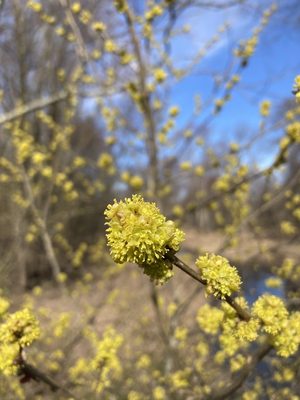
In March, before the leaves, it produces a haze of small chartreuse-gold flowers along the bare stems. From a distance a colony looks like yellow smoke on the woodland floor.
What it feeds
The early bloom is the first of its two contributions. Small native bees and flies work the flowers in March and April, when almost nothing else is open.
The second is the spicebush swallowtail, which lays on this plant and on sassafras and essentially nothing else. Its caterpillar is one of the most remarkable insects in an eastern garden: it folds a leaf around itself, and it carries large false eyespots that make it look convincingly like a small snake, green when young and orange before pupating. Children who will not look at a garden will look at this.
The red fall fruit on female plants is very high in fat and is taken heavily by migrating thrushes, veeries, and wood thrushes fueling for the trip south.
Living with it
Deer browse it, and in high-pressure areas young plants need protection to get established.
Fall color is a clear butter yellow, and in shade it lights up.
The leaves and twigs were used as a tea historically, and the fruit as a spice. It is grown here for the swallowtail and the birds.
Sources: USDA PLANTS Database (native range); Lady Bird Johnson Wildflower Center, University of Texas at Austin (species profile); Cornell Lab of Ornithology (fall migration and high-fat native fruit); University of Florida IFAS Extension (spicebush swallowtail host plants and larval development).
It’s deer-resistant, good fall color, and fragrant.Where it grows
Spicebush is native to the Northeast. In the wild you’ll find it across Alabama · Arkansas · Connecticut · Delaware · Florida · Georgia · Illinois · Indiana · Iowa · Kentucky and 24 more states. Always confirm it suits your specific county with your state native plant society before planting.
Regional Garden has written state guides covering Spicebush in 34 of them so far.
Good for
Where to buy Spicebush
Some links here are affiliate links and we may earn a small commission at no extra cost to you.
What a first-year Spicebush planting needs, from a pH kit to mulch.
Companions & kin.
Natives that share Spicebush’s range and conditions.

Arrowwood Viburnum
Viburnum dentatum
A bulletproof hedge shrub with white spring flowers, blue fall berries, and burgundy autumn leaves.
- Sun to shade
- Average–wet
- 6–10 ft
- Blooms May–Jun
Fragrant Sumac
Rhus aromatica
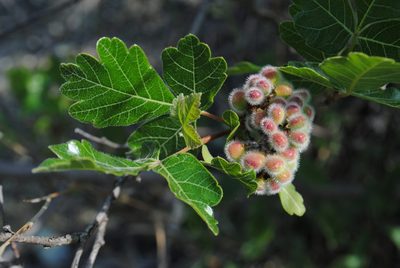
A low, spreading shrub that blankets dry banks and blazes scarlet and orange in fall.
- Full–part sun
- Dry
- 2–6 ft
- Blooms Mar–Apr
American Elderberry
Sambucus canadensis
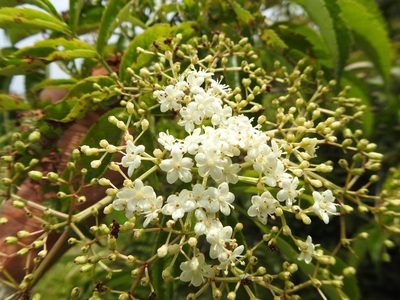
Big lacy flower heads in summer give way to purple-black berries for both birds and your kitchen.
- Full–part sun
- Average–wet
- 6–12 ft
- Blooms Jun–Jul

Buttonbush
Cephalanthus occidentalis
Spherical white 'pincushion' flowers over standing water, swarmed by butterflies and bees.
- Full–part sun
- Average–wet
- 5–10 ft
- Blooms Jun–Aug