- Home
- Plant guide
- Stiff Goldenrod
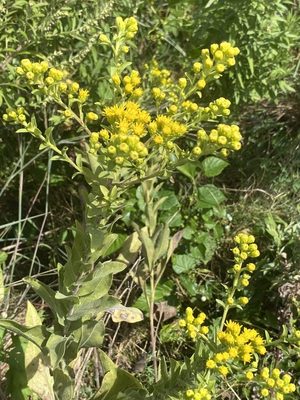
Sandy Wolkenberg (CC BY)
Stiff Goldenrod
Solidago rigida
A prairie goldenrod with flat-topped flower heads that double as a butterfly landing pad.
Native to: the Midwest · the Great Plains · the South-Central region · the Mid-Atlantic · the Southeast
Growing Stiff Goldenrod
Exceptionally tough in clay and drought. One of the most-visited plants in the prairie when it blooms.
Where it belongs
Stiff goldenrod is a prairie species of the Midwest, Plains, Texas, and parts of the Mid-Atlantic and Southeast. It grows in tallgrass prairie, on clay flats, and in the hard, unimproved ground along old railroads.
It reads differently from every other goldenrod. The leaves are thick, rough, and gray-green, closer to a mullein than to a soft prairie perennial, and the stems are stiff enough to feel woody. Botanists have moved it in and out of the genus more than once; some references list it as Oligoneuron rigidum.
Growing it
Full sun, dry to medium moisture, in clay, loam, or rocky ground, zones 3 to 9. Three to five feet.
Clay is where it earns its keep. Heavy soil that goes to concrete in August and to soup in March defeats a long list of perennials, and this one grows in it without complaint. If you have a spot where things keep failing and you suspect the soil, this is a reasonable thing to try there.
It is slow to start. Expect a rosette of big flat leaves the first year and little else. The flowering stems come once the root system is in place.
What it feeds
The flower head is the distinguishing feature: instead of a plume it makes a broad flat top, several inches across, held horizontally.
That shape is a landing platform. Butterflies need somewhere to stand while they feed, and a flat head suits them far better than a nodding spray. Monarchs moving south through the middle of the country work these heads heavily, and so do sulphurs, painted ladies, and every kind of bee.
Goldenrod specialists come to it as well, the native bees whose season is timed to this genus. In late fall goldfinches and juncos take the seed.
Living with it
Deer leave it alone; the rough sandpapery foliage is not worth eating.
Its one bad habit is reseeding. In open bare ground it will produce volunteers, which is welcome in a meadow and less so in a tidy bed. Deadheading before the seed ripens stops it, at the cost of the birds' winter food. In a meadow, let it go.
Standing stems hold their shape through snow. Cut back in spring.
Sources: USDA PLANTS Database (native range and nomenclature); Lady Bird Johnson Wildflower Center, University of Texas at Austin (species profile); Xerces Society (specialist bees and monarch fall migration nectar).
It’s deer-resistant, drought-tolerant, and easy to grow.Where it grows
Stiff Goldenrod is native to the Midwest. In the wild you’ll find it across Alabama · Arkansas · Colorado · Delaware · Florida · Georgia · Illinois · Indiana · Iowa · Kansas and 26 more states. Always confirm it suits your specific county with your state native plant society before planting.
Regional Garden has written state guides covering Stiff Goldenrod in 36 of them so far.
Good for
Where to buy Stiff Goldenrod
Some links here are affiliate links and we may earn a small commission at no extra cost to you.
What a first-year Stiff Goldenrod planting needs, from a pH kit to mulch.
Companions & kin.
Natives that share Stiff Goldenrod’s range and conditions.
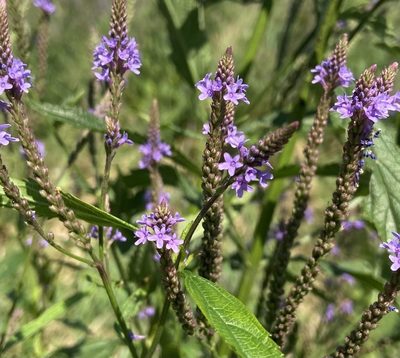
Blue Vervain
Verbena hastata
Candelabras of tiny violet flowers for wet ground, working for small native bees all summer.
- Full–part sun
- Average–wet
- 3–5 ft
- Blooms Jul–Sep
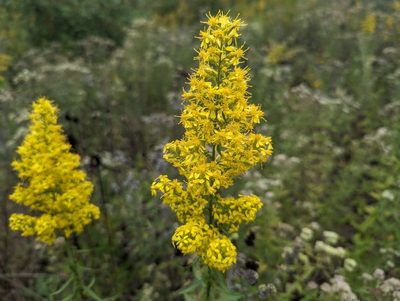
Showy Goldenrod
Solidago speciosa
Upright golden candles that anchor the fall garden, and no, goldenrod doesn't cause hay fever.
- Full–part sun
- Dry–average
- 2–4 ft
- Blooms Sep–Oct
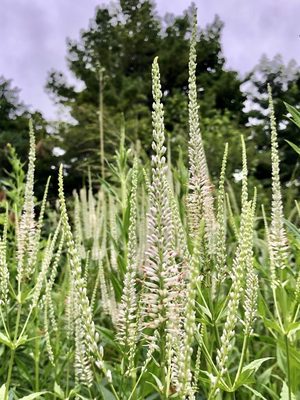
Culver's Root
Veronicastrum virginicum
Elegant white candelabra spires that bring vertical structure and a haze of bees to midsummer.
- Full–part sun
- Average–wet
- 3–5 ft
- Blooms Jun–Aug
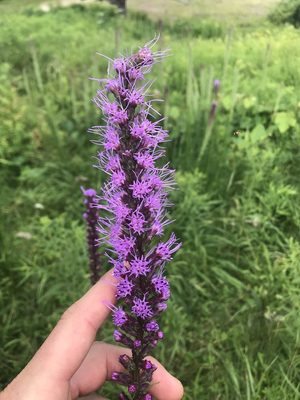
Dense Blazing Star
Liatris spicata
Vertical wands of magenta that open top-down and pull in every swallowtail in the neighborhood.
- Full sun
- Average–wet
- 2–4 ft
- Blooms Jul–Aug