- Home
- Plant guide
- Blue Vervain
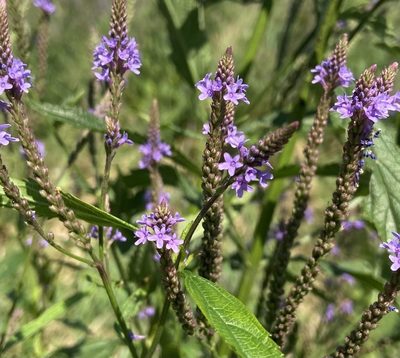
Blue Vervain
Verbena hastata
Candelabras of tiny violet flowers for wet ground, working for small native bees all summer.
Native to: the Northeast · the Mid-Atlantic · the Southeast · the Midwest · the Great Plains
Growing Blue Vervain
Loves a rain garden or pond edge and reseeds in open, damp soil. Sparrows and finches take the seed in fall.
Where it belongs
Blue vervain is native across the East, Midwest, and eastern Plains, growing in wet meadows, ditches, floodplains, marshes, and the disturbed damp ground along field edges. It is genuinely common, which is part of why it gets overlooked.
It reads as a wild plant rather than a garden one: three to five feet of stiff, square, branching stem topped by narrow spikes. In a formal bed it looks untidy. In a rain garden or a damp meadow it looks correct.
Growing it
Full sun to part sun, wet to medium soil, in loam or clay, zones 3 to 8.
Wet is the operative word. It will take standing water for periods and it wants soil that does not dry out. In a dry bed it is short-lived and thin.
It reseeds readily in bare damp ground, which is how it maintains itself in a floodplain. In a rain garden that is usually welcome; elsewhere, cut the spikes before the seed ripens, at the cost of the birds' share.
Individual plants are not especially long-lived. Treat the planting as a population rather than as a set of specimens, and leave some open soil for seedlings.
What it feeds
The flowers are minute and open in a narrow band that creeps up each spike over several weeks, so the plant is in bloom continuously from July into September rather than in one flush.
Small size is the point. These shallow flowers are within reach of the very small native bees, including a group of vervain specialists that collect pollen from this genus and few others. Those bees are almost invisible to a casual observer and are absent from most gardens simply because nothing there fits them.
Larger bees, skippers, and small butterflies take nectar as well. In fall, sparrows, juncos, and cardinals work the seed spikes.
Living with it
Deer usually pass it by. The foliage is bitter, and the plant has a long history of medicinal use that is not a reason to consume it now.
It has a close relative, hoary vervain, which is a dry-prairie species with lavender flowers and fuzzy gray leaves. If your ground is dry, that is the vervain to look for instead.
Leave the spikes standing through winter for the seed and the structure. Cut back in spring.
Sources: USDA PLANTS Database (native range); Lady Bird Johnson Wildflower Center, University of Texas at Austin (species profile); Xerces Society (specialist bees of Verbena).
It’s easy to grow.Where it grows
Blue Vervain is native to the Northeast. In the wild you’ll find it across Alabama · Arkansas · Colorado · Connecticut · Delaware · Florida · Georgia · Illinois · Indiana · Iowa and 32 more states. Always confirm it suits your specific county with your state native plant society before planting.
Regional Garden has written state guides covering Blue Vervain in 42 of them so far.
Good for
Where to buy Blue Vervain
Some links here are affiliate links and we may earn a small commission at no extra cost to you.
What a first-year Blue Vervain planting needs, from a pH kit to mulch.
Companions & kin.
Natives that share Blue Vervain’s range and conditions.
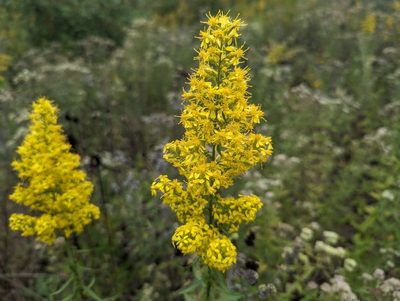
Showy Goldenrod
Solidago speciosa
Upright golden candles that anchor the fall garden, and no, goldenrod doesn't cause hay fever.
- Full–part sun
- Dry–average
- 2–4 ft
- Blooms Sep–Oct
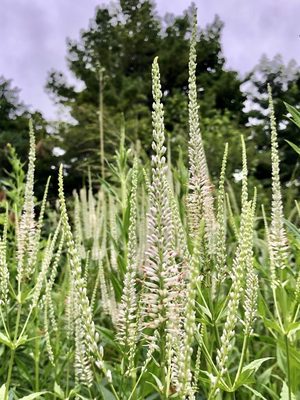
Culver's Root
Veronicastrum virginicum
Elegant white candelabra spires that bring vertical structure and a haze of bees to midsummer.
- Full–part sun
- Average–wet
- 3–5 ft
- Blooms Jun–Aug
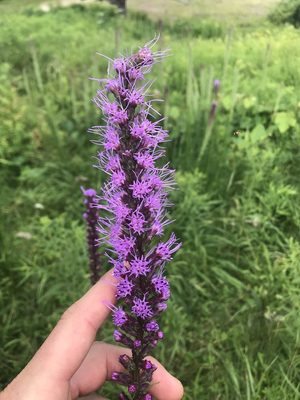
Dense Blazing Star
Liatris spicata
Vertical wands of magenta that open top-down and pull in every swallowtail in the neighborhood.
- Full sun
- Average–wet
- 2–4 ft
- Blooms Jul–Aug
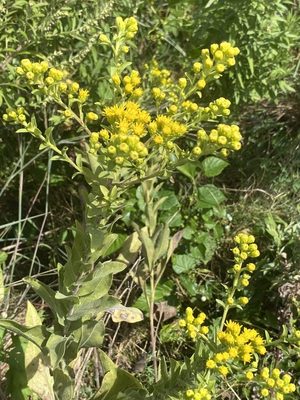
Stiff Goldenrod
Solidago rigida
A prairie goldenrod with flat-topped flower heads that double as a butterfly landing pad.
- Full sun
- Dry–average
- 3–5 ft
- Blooms Aug–Oct