- Home
- Plant guide
- Toyon
Toyon
Heteromeles arbutifolia
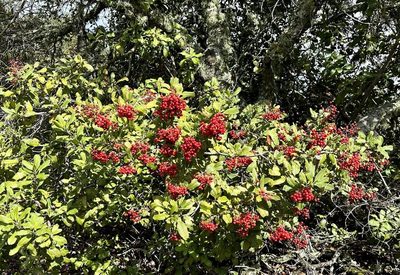
California's evergreen 'Christmas berry,' with white summer flowers and red winter fruit for birds.
Native to: California
Growing Toyon
A cornerstone of the California native hedge, thriving on summer drought once established. The bright berries reportedly gave Hollywood its name.
Where it belongs
Toyon is native to California and the coastal ranges, growing in chaparral, in oak woodland, and on canyon slopes from the coast into the foothills.
It is a cornerstone plant of the California native garden, and a large part of why is that it is evergreen, substantial, and genuinely drought tolerant, which is a combination the state's climate demands and few plants supply.
The connection to Hollywood is often repeated: the shrub is abundant in the hills above Los Angeles, and the neighborhood name is sometimes attributed to it. The etymology is disputed and the story should be treated as folklore rather than fact.
Growing it
Full sun to part sun, dry soil, in loam, rocky ground, or sand, zones 7 to 10. Eight to fifteen feet tall and as wide, and it can reach small tree size with age.
The critical rule for California natives applies here in full: no summer water once established. These plants evolved with wet winters and bone-dry summers, and irrigating them in July invites root pathogens that kill them. Water through the first year or two to establish, then stop.
Plant in fall, before the winter rains, so the roots grow through the wet season.
It takes pruning and can be shaped as a hedge, a screen, or limbed up into a small multi-trunked tree. Prune in late winter.
What it feeds
Flat clusters of small white flowers open in June and July, and they are worked heavily by native bees, flower flies, small wasps, and beetles. Butterflies take nectar.
The fruit ripens red in late fall and persists into winter. It is a major food source for California birds in the lean months: cedar waxwings, robins, mockingbirds, and band-tailed pigeons all take it, and a fruiting shrub can be stripped over a few days when a flock arrives.
The dense evergreen structure is nesting and roosting cover, which in chaparral and in a dry garden is scarce and valuable.
Living with it
Deer generally leave established plants alone.
The fruit is edible cooked and was used by California tribes, though raw it is astringent and contains small amounts of cyanogenic compounds. Leave it for the birds.
Fireblight can affect it in wet years, and shot-hole fungus marks the leaves in overwatered plantings. Both are usually consequences of too much summer water.
Sources: USDA PLANTS Database (native range); Lady Bird Johnson Wildflower Center, University of Texas at Austin (species profile); California Native Plant Society (summer water and establishment guidance); Theodore Payne Foundation (garden culture and wildlife value).
It’s deer-resistant, drought-tolerant, evergreen, and good for winter interest.Where it grows
Toyon is native to California. In the wild you’ll find it across California · Nevada · Oregon. Always confirm it suits your specific county with your state native plant society before planting.
Regional Garden has written state guides covering Toyon in 3 of them so far.
Good for
Where to buy Toyon
Some links here are affiliate links and we may earn a small commission at no extra cost to you.
What a first-year Toyon planting needs, from a pH kit to mulch.
Companions & kin.
Natives that share Toyon’s range and conditions.

Blue Elderberry
Sambucus cerulea
Fast, big, and covered in flat cream flower heads, then dusty blue fruit that draws every fruit-eating bird in the county.
- Full–part sun
- Average–wet
- 8–20 ft
- Blooms Jun–Jul

Golden Currant
Ribes aureum
Yellow spring flowers that smell of cloves, black fruit birds strip in a week, and red foliage in the fall.
- Full–part sun
- Dry–average
- 4–8 ft
- Blooms Apr–May

Buttonbush
Cephalanthus occidentalis
Spherical white 'pincushion' flowers over standing water, swarmed by butterflies and bees.
- Full–part sun
- Average–wet
- 5–10 ft
- Blooms Jun–Aug
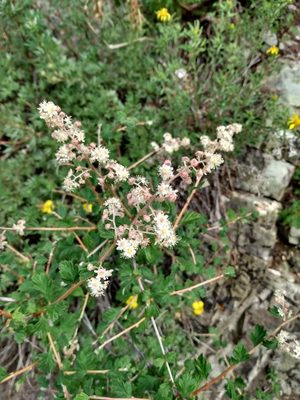
Oceanspray
Holodiscus discolor
Foaming cream plumes in midsummer that dry to tan and stand all winter, on a shrub that takes sun or shade and no water.
- Sun to shade
- Dry–average
- 6–12 ft
- Blooms Jun–Jul