- Home
- Plant guide
- California Lilac
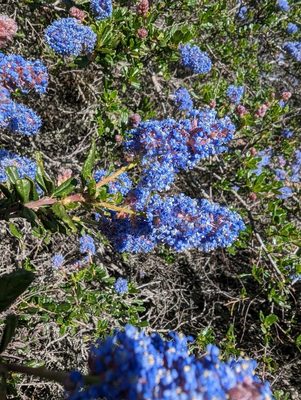
joergmlpts (CC BY)
California Lilac
Ceanothus thyrsiflorus
Sheets of true-blue spring flowers on an evergreen shrub that hums with bees on the West Coast.
Native to: California · the Pacific Northwest
Growing California Lilac
One of the most spectacular native shrubs anywhere when in bloom, and a pollinator powerhouse. Demands fast drainage and zero summer water once established.
Where it belongs
California lilac, or blueblossom, is native to coastal California and southern Oregon, growing in chaparral, coastal scrub, and the edges of redwood and mixed evergreen forest.
Blue is rare among woody plants, and this produces it in quantity: a mature shrub in bloom is a solid mass of blue-violet, and a hillside of them is one of the sights of the western spring. Audible, too. Stand next to one on a warm March day and the bee noise is continuous.
It is not related to true lilacs. The shared name reflects the flower clusters, not the family.
Growing it
Full sun, dry soil, in rocky ground, sand, or lean loam, zones 7 to 10. Six to twenty feet tall depending on the form, and often as wide.
Two rules govern success and both are about water.
First, absolutely no summer water once established. Ceanothus is famously intolerant of summer irrigation, which promotes root rot. Plant it away from lawns and irrigated beds, water through the first winter and spring, then leave it alone.
Second, fast drainage. Heavy clay that stays wet in winter kills it. Plant on a slope or a mound.
It is short-lived by shrub standards, often ten to fifteen years, sometimes less. That is normal and not a failure of care. Plan for replacement rather than expecting a permanent specimen.
It fixes its own nitrogen, so it needs no fertilizer.
Prune lightly and only after flowering. Ceanothus does not resprout reliably from old wood, so a hard cutback can kill it.
What it feeds
The tiny flowers are packed into dense clusters with nectar held shallow, and they open at a point in the year when much of the West is just waking up.
The visitor list is enormous: native bees of many kinds, bumblebees, flower flies, small wasps, and beetles. Specialist bees collect from Ceanothus. Butterflies take nectar, and it is a host plant for the California hairstreak, the spring azure, and the pale swallowtail, among others.
Birds take the seed, and the dense evergreen structure is nesting cover.
Living with it
Deer generally leave it alone, though young plants can be browsed.
Many species and hybrids are sold, from low groundcovers a foot high to shrubs twenty feet tall, and they vary in hardiness and in flower color from pale powder to deep indigo. Choose by mature size and by what is regionally appropriate rather than by flower alone.
Plant in fall so the winter rains establish the roots.
Sources: USDA PLANTS Database (native range); Lady Bird Johnson Wildflower Center, University of Texas at Austin (species profile); California Native Plant Society (Ceanothus culture, summer water intolerance and longevity); Xerces Society (Ceanothus specialist bees and butterfly hosts).
It’s deer-resistant, drought-tolerant, evergreen, showy, and a nitrogen-fixer.Where it grows
California Lilac is native to California. In the wild you’ll find it across California · Nevada · Oregon · Washington. Always confirm it suits your specific county with your state native plant society before planting.
Regional Garden has written state guides covering California Lilac in 4 of them so far.
Good for
Where to buy California Lilac
Some links here are affiliate links and we may earn a small commission at no extra cost to you.
What a first-year California Lilac planting needs, from a pH kit to mulch.
Companions & kin.
Natives that share California Lilac’s range and conditions.

Blue Elderberry
Sambucus cerulea
Fast, big, and covered in flat cream flower heads, then dusty blue fruit that draws every fruit-eating bird in the county.
- Full–part sun
- Average–wet
- 8–20 ft
- Blooms Jun–Jul
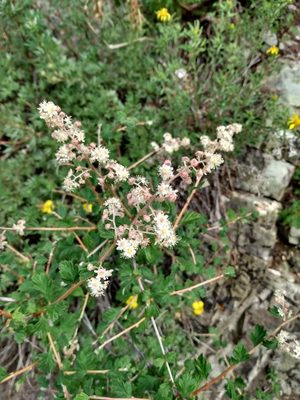
Oceanspray
Holodiscus discolor
Foaming cream plumes in midsummer that dry to tan and stand all winter, on a shrub that takes sun or shade and no water.
- Sun to shade
- Dry–average
- 6–12 ft
- Blooms Jun–Jul

Golden Currant
Ribes aureum
Yellow spring flowers that smell of cloves, black fruit birds strip in a week, and red foliage in the fall.
- Full–part sun
- Dry–average
- 4–8 ft
- Blooms Apr–May
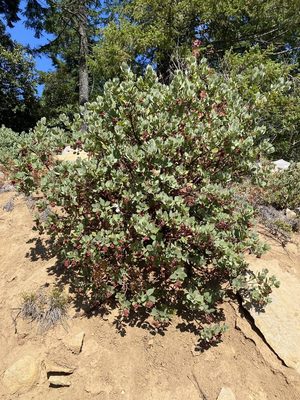
Hairy Manzanita
Arctostaphylos columbiana
Sculptural mahogany bark and early urn-shaped flowers that feed the West Coast's first bees of spring.
- Full–part sun
- Dry
- 3–9 ft
- Blooms Mar–May