- Home
- Plant guide
- Desert Marigold
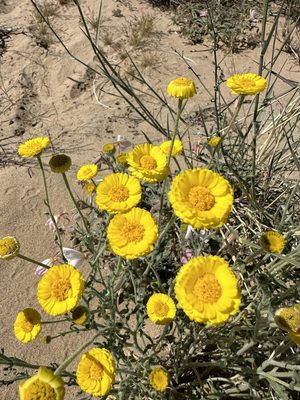
Melanie J. Davis (CC BY)
Desert Marigold
Baileya multiradiata
A silver-leaved desert daisy that blooms almost year-round on rainfall alone.
Native to: the desert Southwest
Growing Desert Marigold
About as drought-proof as a flowering plant gets, reseeding across gravel and decomposed granite. Shear it back after a flush to keep it tidy.
Where it belongs
Desert marigold is native to the Southwest, growing in the Sonoran and Chihuahuan deserts on gravel flats, roadsides, washes, and decomposed granite slopes, often in ground that looks incapable of supporting anything.
It is not related to garden marigolds, which are Mexican and Central American tagetes. The shared name is a coincidence of appearance.
The silver-white foliage is dense wool, and it works the way desert plant hair usually does: it reflects light and slows water loss from the leaf surface. That is a good part of why the plant tolerates conditions that kill ordinary perennials.
Growing it
Full sun, dry soil, in sand or rocky ground, zones 7 to 11. Twelve to eighteen inches.
The failure mode is water. Irrigation, rich soil, and mulch all shorten its life or kill it outright. Plant it in gravel, in unamended desert soil, in the part of the yard the sprinklers do not reach.
It is short-lived, functioning as a perennial in good conditions and as a reseeding annual otherwise, and it maintains itself by seeding into open ground. Leave bare gravel around it rather than mulching, or there will be no next generation.
Bloom is close to continuous where winters are mild, running from March into October and picking up after any decent rain. Shearing the plant back after a flush produces fresh growth and another round.
It is easiest from seed sown directly in fall.
What it feeds
The flower is a flat open daisy with an accessible center, which serves a broad range of insects rather than a specialist few.
Native bees are the main visitors, including small desert species active in the brief windows when conditions allow. Butterflies take nectar. Because the bloom season is so long, it feeds insects across periods when most desert plants are dormant and waiting for rain.
Small birds take the seed.
Living with it
Deer and rabbits mostly leave it alone. The plant is toxic to sheep and is avoided by grazing animals generally.
Its main use in a garden is as a filler and self-sowing matrix between structural plants such as agave, apache plume, or flame acanthus, where it supplies color in the gaps without competing for water.
Shear spent growth, leave the ground open for seedlings, and otherwise do nothing.
Sources: USDA PLANTS Database (native range); Lady Bird Johnson Wildflower Center, University of Texas at Austin (species profile); Desert Botanical Garden (low water garden culture in the Southwest).
It’s deer-resistant, drought-tolerant, long-blooming, and showy.Where it grows
Desert Marigold is native to the desert Southwest. In the wild you’ll find it across Arizona · California · Nevada · New Mexico · Texas · Utah. Always confirm it suits your specific county with your state native plant society before planting.
Regional Garden has written state guides covering Desert Marigold in 6 of them so far.
Good for
Where to buy Desert Marigold
Some links here are affiliate links and we may earn a small commission at no extra cost to you.
What a first-year Desert Marigold planting needs, from a pH kit to mulch.
Companions & kin.
Natives that share Desert Marigold’s range and conditions.
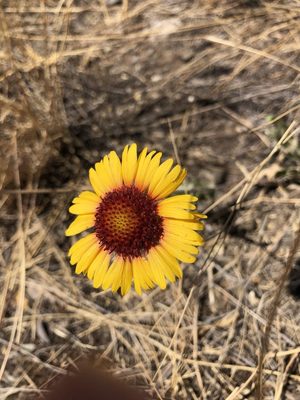
Blanketflower
Gaillardia aristata
Fiery red-and-gold wheels that bloom nonstop all summer on hot, dry, sandy ground.
- Full sun
- Dry
- 1–2.5 ft
- Blooms Jun–Sep
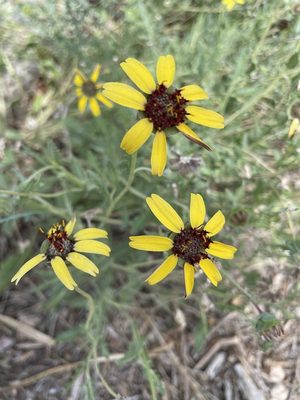
Chocolate Flower
Berlandiera lyrata
Yellow daisies that genuinely smell of chocolate each morning, and bloom all summer in heat.
- Full sun
- Dry
- 1–2 ft
- Blooms May–Sep
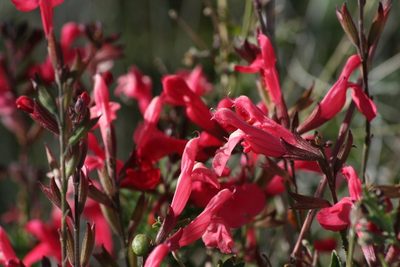
Autumn Sage
Salvia greggii
A tough little evergreen sage that feeds hummingbirds from spring to frost in Texas and the Southwest.
- Full–part sun
- Dry
- 2–3 ft
- Blooms Apr–Oct

Blue Elderberry
Sambucus cerulea
Fast, big, and covered in flat cream flower heads, then dusty blue fruit that draws every fruit-eating bird in the county.
- Full–part sun
- Average–wet
- 8–20 ft
- Blooms Jun–Jul