- Home
- Plant guide
- Flowering Dogwood
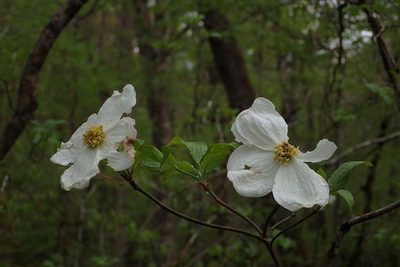
Flowering Dogwood
Cornus florida
The classic understory tree of the eastern woods, with white spring bracts and crimson fall leaves.
Native to: the Northeast · the Mid-Atlantic · the Southeast · the Midwest · the South-Central region
Growing Flowering Dogwood
Happiest in dappled light at a woodland edge, in rich, well-drained soil. The fall berries are high-fat fuel for migrating songbirds.
Where it belongs
Flowering dogwood is native to the Northeast, Mid-Atlantic, Southeast, Midwest, and east Texas, growing beneath the canopy of hardwood forest, at woodland edges, and on shaded slopes. It is the state tree or state flower of several eastern states.
Its habit is distinctive: horizontal tiers of branching that hold the flowers in flat layers, which is why a dogwood in bloom in an open woods reads as floating white shelves.
The four white petals are not petals. They are bracts, modified leaves surrounding a small cluster of true flowers at the center, and the notch at the tip of each bract is where the bud scale was attached.
Growing it
Part sun to shade, medium moisture, in loam, zones 5 to 9. Fifteen to twenty-five feet tall and as wide.
It wants what it has in the wild: dappled light at a woodland edge, rich well-drained soil, and consistent moisture. Full sun with dry soil is where planted dogwoods struggle, and much of the disappointment with this tree traces to that siting.
Dogwood anthracnose, a fungal disease, has killed large numbers of wild dogwoods in the Appalachians and beyond since the late twentieth century. It is worst on stressed trees in cool moist shade at elevation. Good siting, good airflow, and avoiding drought stress are the practical defenses, and disease-resistant selections such as Appalachian Spring are available.
Do not plant it in a lawn where the mower will wound the trunk. Bark injuries are entry points for borers.
What it feeds
The true flowers at the center of the bracts are small and greenish, and they feed early native bees, flies, and beetles in April and May.
It is a strong host plant, supporting well over a hundred species of butterfly and moth caterpillars, and that caterpillar supply is what nesting birds feed their young.
The fruit is the standout. Bright red berries ripen in September and October and are unusually high in fat, which is exactly what a bird needs before a long migratory flight. Thrushes, robins, cardinals, waxwings, and woodpeckers take them, and the timing lines up with peak fall migration.
Fall foliage turns deep crimson and purple-red.
Living with it
Deer browse young trees heavily.
Two related trees are worth knowing. Kousa dogwood, from Asia, is more disease resistant, blooms later, and supports far fewer native insects. Pacific dogwood is the western species and fills the same role there.
Water it in dry summers, particularly in its first several years.
Sources: USDA PLANTS Database (native range); Lady Bird Johnson Wildflower Center, University of Texas at Austin (species profile); US Forest Service (dogwood anthracnose distribution and management); Cornell Lab of Ornithology (high-fat fall fruit and migration).
It’s showy, and good fall color.Where it grows
Flowering Dogwood is native to the Northeast. In the wild you’ll find it across Alabama · Arkansas · Connecticut · Delaware · Florida · Georgia · Illinois · Indiana · Iowa · Kentucky and 24 more states. Always confirm it suits your specific county with your state native plant society before planting.
Regional Garden has written state guides covering Flowering Dogwood in 34 of them so far.
Good for
Where to buy Flowering Dogwood
Some links here are affiliate links and we may earn a small commission at no extra cost to you.
What a first-year Flowering Dogwood planting needs, from a pH kit to mulch.
Companions & kin.
Natives that share Flowering Dogwood’s range and conditions.
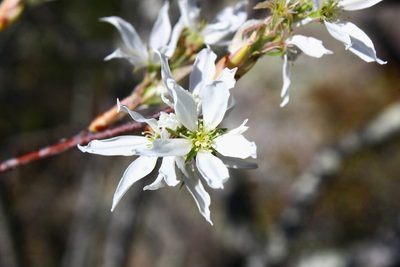
Serviceberry
Amelanchier canadensis
A small four-season tree: white spring flowers, June berries for the birds, and fiery fall color.
- Full–part sun
- Average–wet
- 15–25 ft
- Blooms Apr–May
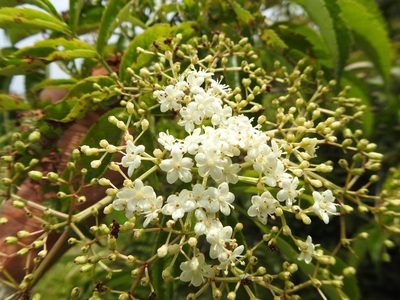
American Elderberry
Sambucus canadensis
Big lacy flower heads in summer give way to purple-black berries for both birds and your kitchen.
- Full–part sun
- Average–wet
- 6–12 ft
- Blooms Jun–Jul
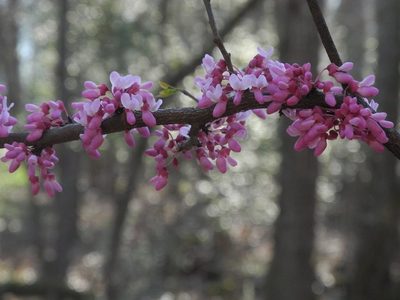
Eastern Redbud
Cercis canadensis
Bare branches erupt in rose-magenta in early spring, and the flowers feed the season's first bees.
- Full–part sun
- Dry–average
- 20–30 ft
- Blooms Mar–Apr

Arrowwood Viburnum
Viburnum dentatum
A bulletproof hedge shrub with white spring flowers, blue fall berries, and burgundy autumn leaves.
- Sun to shade
- Average–wet
- 6–10 ft
- Blooms May–Jun