- Home
- Plant guide
- Nootka Rose
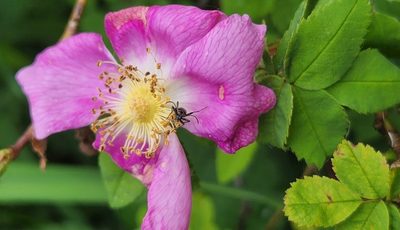
Casey H. Richart (CC BY)
Nootka Rose
Rosa nutkana
One ring of pink petals, a real rose scent, and hips that stay scarlet on bare canes all winter.
Native to: the Pacific Northwest · the Great Basin · the Mountain West
Growing Nootka Rose
A thicket-forming wild rose, so give it room or a bank to hold rather than a tidy border. Single flowers mean pollen a bee can actually reach, which the doubled garden roses do not offer.
Where it belongs
Nootka rose grows from Alaska down the Pacific coast and inland through the northern Rockies, in coastal bluffs, streambanks, meadow edges, thickets and roadsides. It handles salt spray, which makes it one of the better shrubs for exposed coastal ground.
The flowers are single: five broad pink petals around a boss of yellow stamens, two to three inches across, with a genuine rose scent. They open in late spring and are followed by round scarlet hips that hold into winter.
Growing it
It is a thicket-forming wild rose, three to nine feet, armed with paired thorns, and it spreads by suckering. That is the plant's nature and not a fault, but it decides where it belongs: a bank, a boundary, a rough hedge, a wet corner.
Sun or part shade, and ordinary to moist soil. It tolerates clay and seasonal wet better than most roses and will also take a dry summer once established.
Prune by removing the oldest canes at the base in late winter. Do not shear it into a shape it does not have.
Blackspot and rust show up on the foliage some years. On a wild rose in a rough planting this is cosmetic, and spraying a shrub grown for pollinators is self-defeating.
What it feeds
A single rose is worth far more to insects than a doubled garden rose, because doubling replaces the stamens with petals and removes the pollen. Bumblebees and solitary bees work these heavily, and several specialist bees collect rose pollen.
Leafcutter bees take neat semicircular pieces from the leaves for their nest cells. The holes are a sign the planting is working.
The hips feed waxwings, robins, grosbeaks and grouse through winter, and the thorny thicket is nesting and escape cover for small birds.
Living with it
Plant it where the suckering helps: holding a slope, filling a boundary, screening a fence. Give it three to six feet from a path, since the thorns are serious.
The hips against bare red-brown canes are the winter picture, so leave them.
It’s fragrant, deer-resistant, good for winter interest, easy to grow, and salt-tolerant.Where it grows
Nootka Rose is native to the Pacific Northwest. In the wild you’ll find it across Arizona · California · Colorado · Idaho · Montana · Nevada · New Mexico · Oregon · Utah · Washington and 1 more states. Always confirm it suits your specific county with your state native plant society before planting.
Regional Garden has written state guides covering Nootka Rose in 11 of them so far.
Good for
Where to buy Nootka Rose
Some links here are affiliate links and we may earn a small commission at no extra cost to you.
What a first-year Nootka Rose planting needs, from a pH kit to mulch.
Companions & kin.
Natives that share Nootka Rose’s range and conditions.
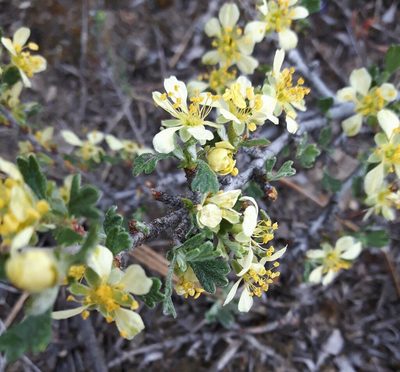
Antelope Bitterbrush
Purshia tridentata
A sagebrush-country shrub that fixes its own nitrogen, feeds native bees in spring, and never wants watering.
- Full sun
- Dry
- 3–8 ft
- Blooms Apr–Jun

Blue Elderberry
Sambucus cerulea
Fast, big, and covered in flat cream flower heads, then dusty blue fruit that draws every fruit-eating bird in the county.
- Full–part sun
- Average–wet
- 8–20 ft
- Blooms Jun–Jul
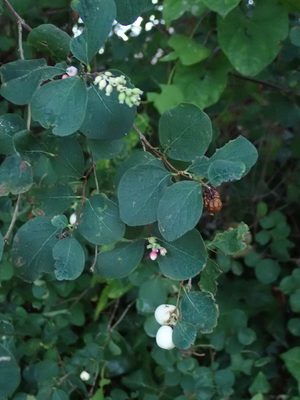
Common Snowberry
Symphoricarpos albus
The shrub that will grow where nothing else will, and hangs white berries on bare stems all winter.
- Sun to shade
- Dry–average
- 3–6 ft
- Blooms Jun–Jul

Golden Currant
Ribes aureum
Yellow spring flowers that smell of cloves, black fruit birds strip in a week, and red foliage in the fall.
- Full–part sun
- Dry–average
- 4–8 ft
- Blooms Apr–May