- Home
- Plant guide
- Oregon Sunshine
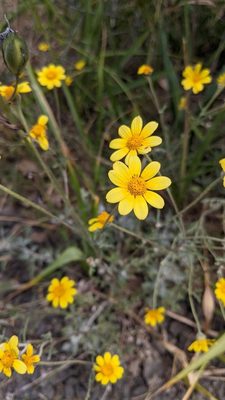
Brodie Cass Talbott (CC BY)
Oregon Sunshine
Eriophyllum lanatum
Silver-woolly foliage under golden daisies, on a plant that treats a hot dry summer as normal weather.
Native to: the Pacific Northwest · California · the Great Basin
Growing Oregon Sunshine
The wool on the leaves is what lets it hold water, and it is also why the plant hates wet winter ground. Give it a slope, a gravel bed, or a raised edge.
Where it belongs
Oregon sunshine grows from British Columbia south through California and east into the Great Basin, on dry open slopes, bluffs, rocky ridges, road cuts and thin serpentine soils. It is one of the most common yellow daisies of the dry West and one of the easiest to place in a garden.
The whole plant is covered in fine white wool, which gives the foliage a silver cast and is how it survives sun and drought. The flower heads are golden yellow and carried on short stems above the leaves through early summer.
Growing it
Full sun and drainage. That is the entire requirement, and neither is optional.
The wool that lets the plant hold water in July also holds it in December, and in ground that stays wet through winter the crown rots. A slope, a gravel bed, a raised edge, the top of a wall or a wide shallow container all solve this. Heavy clay that sits wet does not, whatever you add to the planting hole.
It takes no summer water once established, and irrigation produces a loose, leggy plant that flops open in the middle.
Shear it lightly after the main flush of bloom to tidy it and often to get a second, smaller round of flowers. Do not cut into the woody base.
Individual plants are not especially long-lived. Letting some seed fall keeps a patch going.
What it feeds
The open daisy shape is accessible to almost everything: small native bees, sweat bees, syrphid flies, beetles and butterflies all work it, and several specialist bees are tied to it and its relatives.
The seed is taken by goldfinches and other small birds if the heads are left standing.
Living with it
It suits the places gardens usually give up on: a hell strip, a driveway edge, a south-facing slope, a rock garden, the gravel around a patio.
Plant it in a drift rather than singly, with a bunchgrass behind it and a buckwheat beside it, and it looks like the dry meadow it came from.
It’s drought-tolerant, deer-resistant, showy, easy to grow, and long-blooming.Where it grows
Oregon Sunshine is native to the Pacific Northwest. In the wild you’ll find it across California · Colorado · Idaho · Montana · Nevada · Oregon · Utah · Washington · Wyoming. Always confirm it suits your specific county with your state native plant society before planting.
Regional Garden has written state guides covering Oregon Sunshine in 9 of them so far.
Good for
Where to buy Oregon Sunshine
Some links here are affiliate links and we may earn a small commission at no extra cost to you.
What a first-year Oregon Sunshine planting needs, from a pH kit to mulch.
Companions & kin.
Natives that share Oregon Sunshine’s range and conditions.
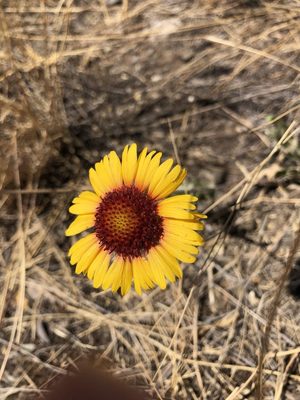
Blanketflower
Gaillardia aristata
Fiery red-and-gold wheels that bloom nonstop all summer on hot, dry, sandy ground.
- Full sun
- Dry
- 1–2.5 ft
- Blooms Jun–Sep

Common Yarrow
Achillea millefolium
A near-continental native with flat flower heads that feed tiny beneficial insects, tough as a weed.
- Full sun
- Dry–average
- 1.5–3 ft
- Blooms May–Aug
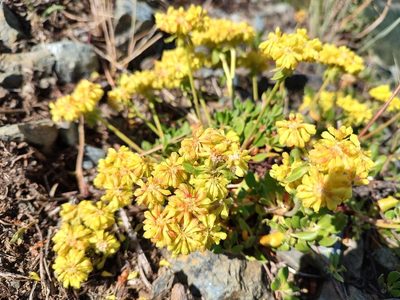
Sulphur-Flower Buckwheat
Eriogonum umbellatum
A low evergreen mat that turns sulphur yellow in midsummer, then rust, and feeds more butterflies than almost anything else on dry ground.
- Full sun
- Dry
- 6–18 in
- Blooms Jun–Aug

Blue Elderberry
Sambucus cerulea
Fast, big, and covered in flat cream flower heads, then dusty blue fruit that draws every fruit-eating bird in the county.
- Full–part sun
- Average–wet
- 8–20 ft
- Blooms Jun–Jul