- Home
- Plant guide
- Sulphur-Flower Buckwheat
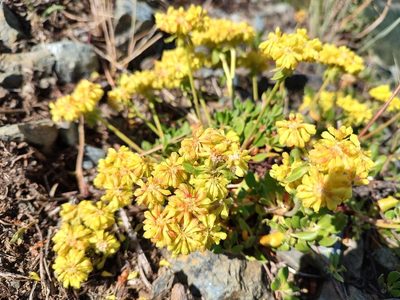
Sulphur-Flower Buckwheat
Eriogonum umbellatum
A low evergreen mat that turns sulphur yellow in midsummer, then rust, and feeds more butterflies than almost anything else on dry ground.
Native to: the Pacific Northwest · the Great Basin · the Mountain West · California
Growing Sulphur-Flower Buckwheat
The buckwheats are the backbone of dry Western pollinator planting, and this is the most garden-tolerant of them. It needs drainage and full sun; on watered ground it sprawls and rots.
Where it belongs
The wild buckwheats are the backbone of dry Western plant communities, and this is the one most likely to work in a garden. It grows on rocky slopes, road cuts, ridgelines and thin gravel soils from the Cascades through the Great Basin and into the Rockies, in places that go three months without rain.
It makes a flat evergreen mat of small spoon-shaped leaves, green above and felted white beneath, and in midsummer sends up short stems carrying tight umbels of sulphur-yellow flowers. Those age through orange to rust and hold their shape into winter.
Growing it
Drainage first, sun second, and then nothing.
It wants gravel, sand, decomposed granite or a rocky bank. In heavy clay or in an irrigated bed it grows soft, sprawls open in the middle and rots at the crown. If your soil holds water in winter, plant it raised, on a slope or in a gravel bed rather than trying to amend the whole area.
Do not fertilize it. Rich ground produces floppy growth on a plant whose whole architecture depends on being lean and tight.
Cut nothing back in fall. The rust-colored seed heads are half the reason to grow it, and they carry the planting through a season when dry gardens have little else standing.
What it feeds
Buckwheats feed a wider range of insects than their size suggests. The shallow flowers suit small native bees that cannot work deep tubular blooms, and several specialist bees visit Eriogonum and little else.
They are also larval host plants for a long list of Western butterflies, including several blues and coppers, which is a role no imported dry-garden plant fills. Expect chewed leaves in a good year.
Living with it
Use it where a lawn would be absurd: a hell strip, a south-facing slope, the top of a wall, a gravel bed by a driveway. It also sits well in a wide shallow container, where the drainage takes care of itself.
Individual plants live for years but not forever. Letting a few seed heads shatter where they fall keeps a colony going without any effort.
It’s drought-tolerant, deer-resistant, evergreen, showy, and good for winter interest.Where it grows
Sulphur-Flower Buckwheat is native to the Pacific Northwest. In the wild you’ll find it across Arizona · California · Colorado · Idaho · Montana · Nevada · New Mexico · Oregon · Utah · Washington and 1 more states. Always confirm it suits your specific county with your state native plant society before planting.
Regional Garden has written state guides covering Sulphur-Flower Buckwheat in 11 of them so far.
Good for
Where to buy Sulphur-Flower Buckwheat
Some links here are affiliate links and we may earn a small commission at no extra cost to you.
What a first-year Sulphur-Flower Buckwheat planting needs, from a pH kit to mulch.
Companions & kin.
Natives that share Sulphur-Flower Buckwheat’s range and conditions.

Common Yarrow
Achillea millefolium
A near-continental native with flat flower heads that feed tiny beneficial insects, tough as a weed.
- Full sun
- Dry–average
- 1.5–3 ft
- Blooms May–Aug
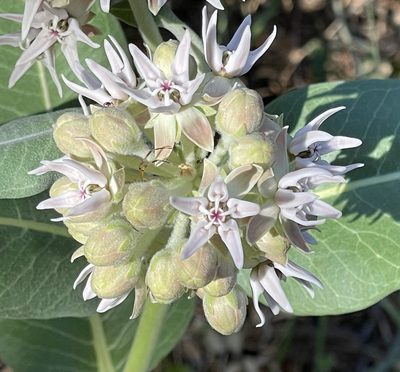
Showy Milkweed
Asclepias speciosa
The West's monarch milkweed, bolder, fuzzier, and more drought-hardy than its eastern cousins.
- Full sun
- Dry–average
- 2–4 ft
- Blooms Jun–Jul

Blue Elderberry
Sambucus cerulea
Fast, big, and covered in flat cream flower heads, then dusty blue fruit that draws every fruit-eating bird in the county.
- Full–part sun
- Average–wet
- 8–20 ft
- Blooms Jun–Jul
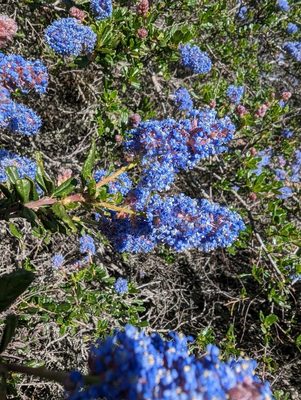
California Lilac
Ceanothus thyrsiflorus
Sheets of true-blue spring flowers on an evergreen shrub that hums with bees on the West Coast.
- Full sun
- Dry
- 6–20 ft
- Blooms Mar–May