- Home
- Plant guide
- Prairie Blazing Star
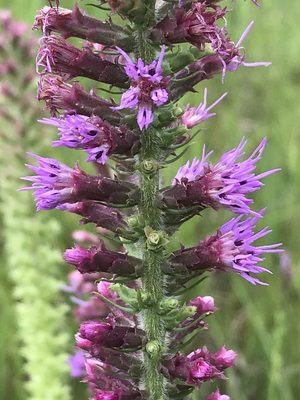
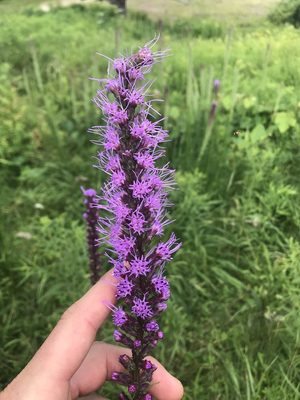
Laura Clark (CC BY)
Prairie Blazing Star
Liatris pycnostachya
The tallest blazing star, a five-foot torch of purple over the high-summer prairie.
Native to: the Midwest · the Great Plains · the South-Central region · the Southeast
Growing Prairie Blazing Star
Wants full sun and good drainage; may need support in rich soil. Monarchs and tiger swallowtails work it relentlessly.
Where it belongs
Prairie blazing star belongs to the tallgrass country: the Midwest, the Plains, Texas, and the western edge of the Southeast. It grows in mesic prairie, on loess bluffs, and in the deep-soil grassland that once ran from Illinois to Kansas.
It is built to the scale of that landscape. Where dense blazing star tops out around four feet, this reaches five, occasionally more, and the flower spike alone can run a foot and a half. In a small bed it is out of proportion. Against big grasses it is exactly right.
Growing it
Full sun, dry to medium moisture, in loam, clay, or rocky ground, zones 3 to 9.
Drainage is the requirement that dense blazing star waives and this one does not. Wet winter ground rots the corm. Slope, raised ground, or naturally draining soil all work.
The height comes with a caveat: in rich, moist, sheltered garden soil the stems grow soft and lean after storms. In lean prairie soil surrounded by grasses they stand. If you want it upright, plant it hard and plant it with big bluestem or indian grass around it, which is both how it grows in the wild and the reason it stays vertical there.
Give it three years. The corm has to build before the tall stems appear.
What it feeds
The bloom lands in July and August, the peak of butterfly activity in the middle of the country. Monarchs and tiger swallowtails work it relentlessly, and a stand in flower is one of the few plantings that reliably holds several butterflies at once.
Bumblebees and long-tongued native bees take nectar; liatris specialists collect the pollen. Goldfinches move in for the seed in September and often nest late enough to be feeding young on prairie seed.
Living with it
Deer avoid it. Voles and mice will take corms, particularly in a mulched bed in the first winter.
Do not fertilize. Added nitrogen produces exactly the soft, falling growth you are trying to avoid.
The dried spikes are structural through winter and hold snow well. Leave them standing and cut back in early spring, before the new basal growth is far up.
Sources: USDA PLANTS Database (native range); Lady Bird Johnson Wildflower Center, University of Texas at Austin (species profile); Xerces Society (butterfly nectar plants of the tallgrass prairie).
It’s deer-resistant, drought-tolerant, showy, and a good cut flower.Where it grows
Prairie Blazing Star is native to the Midwest. In the wild you’ll find it across Alabama · Arkansas · Colorado · Delaware · Florida · Georgia · Illinois · Indiana · Iowa · Kansas and 24 more states. Always confirm it suits your specific county with your state native plant society before planting.
Regional Garden has written state guides covering Prairie Blazing Star in 34 of them so far.
Good for
Where to buy Prairie Blazing Star
Some links here are affiliate links and we may earn a small commission at no extra cost to you.
What a first-year Prairie Blazing Star planting needs, from a pH kit to mulch.
Companions & kin.
Natives that share Prairie Blazing Star’s range and conditions.
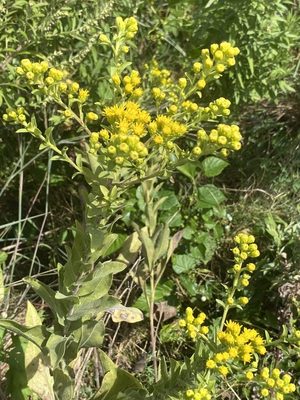
Stiff Goldenrod
Solidago rigida
A prairie goldenrod with flat-topped flower heads that double as a butterfly landing pad.
- Full sun
- Dry–average
- 3–5 ft
- Blooms Aug–Oct
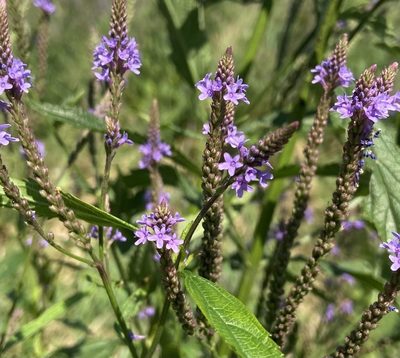
Blue Vervain
Verbena hastata
Candelabras of tiny violet flowers for wet ground, working for small native bees all summer.
- Full–part sun
- Average–wet
- 3–5 ft
- Blooms Jul–Sep
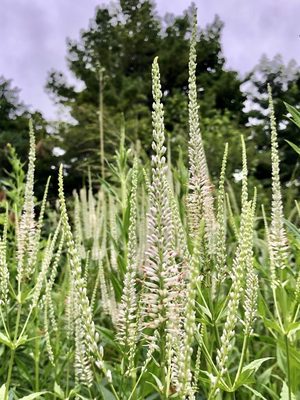
Culver's Root
Veronicastrum virginicum
Elegant white candelabra spires that bring vertical structure and a haze of bees to midsummer.
- Full–part sun
- Average–wet
- 3–5 ft
- Blooms Jun–Aug
Dense Blazing Star
Liatris spicata
Vertical wands of magenta that open top-down and pull in every swallowtail in the neighborhood.
- Full sun
- Average–wet
- 2–4 ft
- Blooms Jul–Aug