- Home
- Plant guide
- Purple Prairie Clover
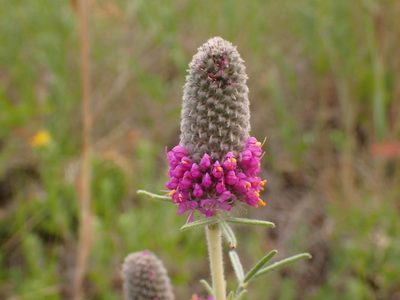
Purple Prairie Clover
Dalea purpurea
Thimble-shaped flowers ringed in orange pollen, a nitrogen-fixing backbone of the dry prairie.
Native to: the Midwest · the Great Plains · the South-Central region · the Mountain West
Growing Purple Prairie Clover
A deep taproot makes it bulletproof in drought once established. Feeds an outsized share of specialist prairie bees.
Where it belongs
Purple prairie clover grows through the Midwest, the Plains, Texas, and the Mountain West, in dry and mesic prairie, on gravel hills, limestone glades, and sandy ground.
It is a legume, in the pea family with the beans and the lupines, and the family membership matters practically. Nodules on its roots host bacteria that convert atmospheric nitrogen into a form plants can use. In a prairie planting, legumes are the reason the system feeds itself.
Growing it
Full sun, dry soil, in loam, rocky ground, or sand, zones 3 to 8. One to three feet, fine-textured and airy rather than bulky.
Sharp drainage and no fertilizer. Nitrogen you add mostly benefits the grasses and weeds around it, which then shade it out. This is a plant that does better on poor ground than on good.
The taproot is the reason for its toughness. It goes down several feet and makes the plant essentially drought-proof once established, at the cost of being impossible to transplant later. Sow seed where it will grow, inoculated with the appropriate rhizobium, or plant small nursery stock in its final position.
Give it two or three years before judging it.
What it feeds
The flower is unusual and worth looking at closely. Tiny flowers open in a narrow ring that starts at the bottom of a dense cylindrical head and moves upward over about two weeks, so at any moment there is a bright band of rose purple circling the head with bright orange anthers sticking out.
That band is where the bees are. It is heavily used by native bees, and a notable share of them are specialists tied to Dalea and its relatives, meaning they collect pollen from this genus and few others. Removing prairie legumes from a landscape removes those bees with them.
It is also a host plant for several small butterflies including dogface sulphurs, and its seed feeds birds.
Living with it
Deer generally leave it alone, though it is palatable to livestock and was a valued forage plant on the open range.
Rabbits will browse young plants. A cage over new seedlings for the first season is worth the trouble in a yard with rabbits.
No staking, no dividing, no feeding. Leave the seed heads for winter and cut back in spring.
Sources: USDA PLANTS Database (native range); Lady Bird Johnson Wildflower Center, University of Texas at Austin (species profile); Xerces Society (specialist bees of prairie legumes); USDA Natural Resources Conservation Service (nitrogen fixation and forage value).
It’s deer-resistant, drought-tolerant, and a nitrogen-fixer.Where it grows
Purple Prairie Clover is native to the Midwest. In the wild you’ll find it across Arizona · Arkansas · Colorado · Idaho · Illinois · Indiana · Iowa · Kansas · Kentucky · Louisiana and 18 more states. Always confirm it suits your specific county with your state native plant society before planting.
Regional Garden has written state guides covering Purple Prairie Clover in 28 of them so far.
Good for
Where to buy Purple Prairie Clover
Some links here are affiliate links and we may earn a small commission at no extra cost to you.
What a first-year Purple Prairie Clover planting needs, from a pH kit to mulch.
Companions & kin.
Natives that share Purple Prairie Clover’s range and conditions.
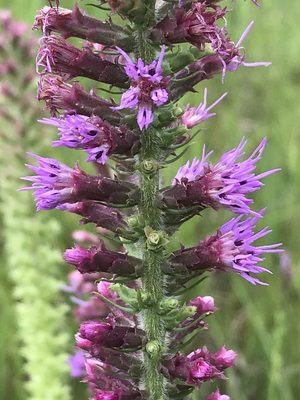
Prairie Blazing Star
Liatris pycnostachya
The tallest blazing star, a five-foot torch of purple over the high-summer prairie.
- Full sun
- Dry–average
- 3–5 ft
- Blooms Jul–Aug
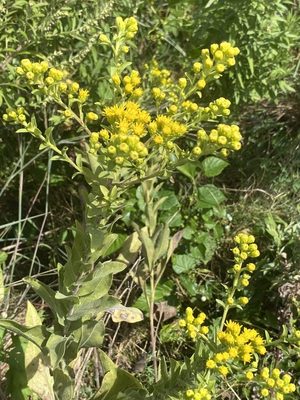
Stiff Goldenrod
Solidago rigida
A prairie goldenrod with flat-topped flower heads that double as a butterfly landing pad.
- Full sun
- Dry–average
- 3–5 ft
- Blooms Aug–Oct
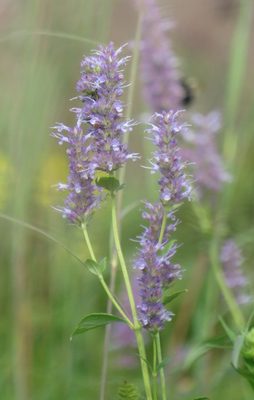
Anise Hyssop
Agastache foeniculum
Months of lavender spikes over licorice-scented foliage, mobbed by bees from dawn to dusk.
- Full–part sun
- Dry–average
- 2–4 ft
- Blooms Jun–Sep
Blue Vervain
Verbena hastata
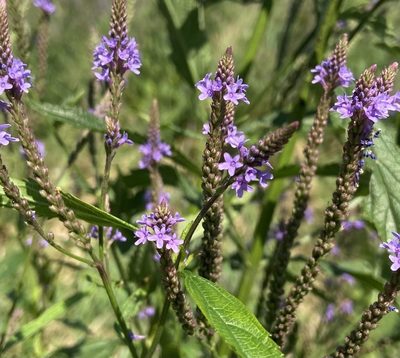
Candelabras of tiny violet flowers for wet ground, working for small native bees all summer.
- Full–part sun
- Average–wet
- 3–5 ft
- Blooms Jul–Sep