- Home
- Plant guide
- Common Camas
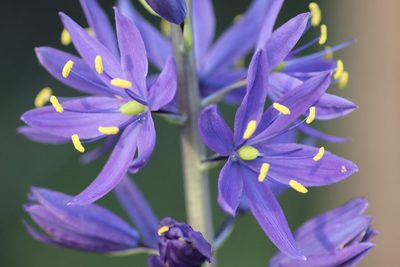
Common Camas
Camassia quamash
The blue that used to run across Northwest prairies in spring, and the one bulb that actually wants a wet winter.
Native to: the Pacific Northwest · the Great Basin · the Mountain West
Growing Common Camas
Wants ground that is wet in winter and spring and bakes dry in summer, which is the pattern most of the Northwest already has. It goes dormant by midsummer, so plant it where something else fills the gap.
Where it belongs
Camas is a prairie bulb of the Pacific Northwest and the northern Great Basin, growing where the ground is soaked from the first fall rain until late spring and then bakes hard through summer. That is not a difficult site. It is the ordinary weather pattern of most of the region, and it is the reason so many imported bulbs sulk here while this one does not.
Whole valley floors used to turn blue with it in April. The bulbs were a staple food for Coast Salish, Nez Perce, Kalapuya and many other peoples, tended in managed prairies over generations, and the plant reads as a garden flower today partly because it was a crop first.
Growing it
Plant the bulbs in fall, four inches deep, in ground that gets wet in winter. Heavy soil is fine. Ground that stays dry all winter under an eave or a conifer is the one place it struggles.
Then leave it alone. Camas does not want summer water, and the standard mistake is planting it in an irrigated border where it rots in its second year. A lawn that is not watered in July suits it exactly, as does the low corner of a yard where winter runoff collects.
The foliage yellows and disappears by midsummer. That is dormancy, not failure. Plan for something nearby that fills the space afterward, or accept a bare patch for the second half of the season.
What it feeds
The flowers open early, when little else is out and queen bumblebees are looking for the first real forage of the year. Mining bees and mason bees work it hard, and several specialist bees collect camas pollen and nothing much else.
Deer generally leave the foliage alone. The bulbs are another matter where gophers are active, and a wire basket at planting is the usual answer.
Living with it
A single bulb is a thin blue spike. Fifty of them scattered through unmown grass is the effect worth having, and the planting only improves as the clumps divide themselves over the years.
One caution, stated plainly: death camas, Toxicoscordion venenosum, grows in the same meadows, looks similar out of bloom, and is poisonous. Its flowers are cream, not blue. Nothing here is a foraging guide, and bulbs bought from a nursery are the safe way to grow this plant.
It’s deer-resistant, showy, and easy to grow.Where it grows
Common Camas is native to the Pacific Northwest. In the wild you’ll find it across Arizona · California · Colorado · Idaho · Montana · Nevada · New Mexico · Oregon · Utah · Washington and 1 more states. Always confirm it suits your specific county with your state native plant society before planting.
Regional Garden has written state guides covering Common Camas in 11 of them so far.
Good for
Where to buy Common Camas
Some links here are affiliate links and we may earn a small commission at no extra cost to you.
What a first-year Common Camas planting needs, from a pH kit to mulch.
Companions & kin.
Natives that share Common Camas’s range and conditions.
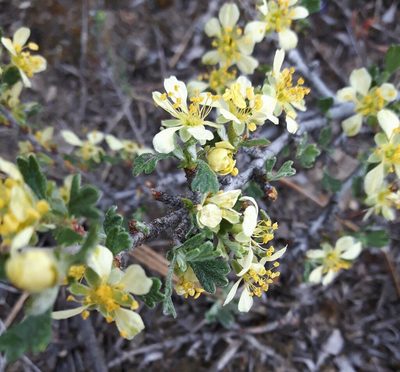
Antelope Bitterbrush
Purshia tridentata
A sagebrush-country shrub that fixes its own nitrogen, feeds native bees in spring, and never wants watering.
- Full sun
- Dry
- 3–8 ft
- Blooms Apr–Jun

Common Yarrow
Achillea millefolium
A near-continental native with flat flower heads that feed tiny beneficial insects, tough as a weed.
- Full sun
- Dry–average
- 1.5–3 ft
- Blooms May–Aug
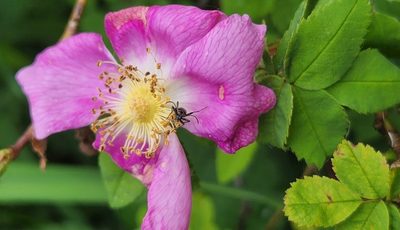
Nootka Rose
Rosa nutkana
One ring of pink petals, a real rose scent, and hips that stay scarlet on bare canes all winter.
- Full–part sun
- Average–wet
- 3–9 ft
- Blooms May–Jun

Prairie Smoke
Geum triflorum
Nodding pink spring bells that turn into smoky, feathered seed plumes, the show after the flower.
- Full–part sun
- Dry
- 6–16 in
- Blooms Apr–May