- Home
- Plant guide
- Foamflower
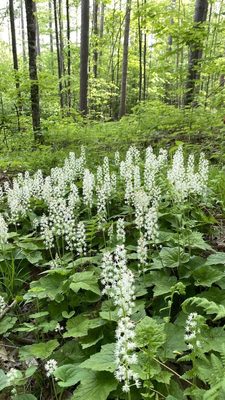
Foamflower
Tiarella cordifolia
Frothy white spring spires over heart-shaped, semi-evergreen foliage in deep shade.
Native to: the Northeast · the Mid-Atlantic · the Southeast · the Midwest
Growing Foamflower
One of the best native evergreen groundcovers for shade, spreading politely by runners. Handsome even out of bloom.
Where it belongs
Foamflower is native to the Northeast, Mid-Atlantic, Southeast, and parts of the Midwest, growing in rich moist woods, along shaded stream banks, and on cool mountain slopes, often in considerable shade.
It is the native alternative most often reached for when someone wants to stop planting English ivy, periwinkle, or pachysandra under trees. Those three are evergreen, spreading, and shade-tolerant, and two of them are invasive across much of the East. Foamflower does the same job.
Growing it
Part sun to shade, medium moisture, in loam, zones 3 to 8. Six to twelve inches in leaf, taller in bloom.
Rich soil with leaf litter and consistent moisture. It is more tolerant of deep shade than most flowering perennials and less tolerant of drought. On a dry slope it struggles; in a cool moist hollow it thrives.
It spreads by above-ground runners, politely, extending a foot or so a year into a continuous mat. It does not need dividing, though lifting and separating rooted runners is the easy way to expand a planting for free.
The foliage is semi-evergreen: maple-shaped, often marked with dark veining, and it holds through winter in milder zones, bronzing in cold. That is what makes it useful when nothing is flowering.
What it feeds
The flower spires open in April and May, a mass of tiny white flowers with long stamens that give the whole spike a foamy look, which is where the name comes from.
The flowers are small and shallow, and the visitors are correspondingly small: mining bees, sweat bees, small carpenter bees, and flower flies. Those insects are active early in spring, in cool weather, when larger bees are still underground.
It is not a high-volume nectar plant. Its contribution is timing and location, providing forage in a shaded spot in early spring where most gardens offer nothing.
Living with it
Deer generally avoid it, which is rare among shade groundcovers and a large part of its practical value.
Named selections are widely sold, many of them hybrids with the western foamflower or with heuchera. The straight species spreads by runners; several hybrids are clumpers that will not knit together into a groundcover. Read the label if coverage is what you want.
Leave it alone over winter. Trim any winter-damaged leaves in early spring.
Sources: USDA PLANTS Database (native range); Lady Bird Johnson Wildflower Center, University of Texas at Austin (species profile); Mt. Cuba Center (Tiarella trial results on spread habit and garden performance).
It’s deer-resistant, evergreen, and showy.Where it grows
Foamflower is native to the Northeast. In the wild you’ll find it across Alabama · Arkansas · Connecticut · Delaware · Florida · Georgia · Illinois · Indiana · Iowa · Kentucky and 24 more states. Always confirm it suits your specific county with your state native plant society before planting.
Regional Garden has written state guides covering Foamflower in 34 of them so far.
Good for
Where to buy Foamflower
Some links here are affiliate links and we may earn a small commission at no extra cost to you.
What a first-year Foamflower planting needs, from a pH kit to mulch.
Companions & kin.
Natives that share Foamflower’s range and conditions.
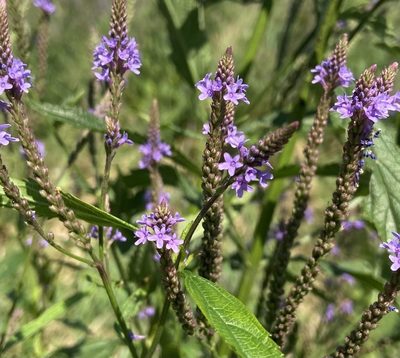
Blue Vervain
Verbena hastata
Candelabras of tiny violet flowers for wet ground, working for small native bees all summer.
- Full–part sun
- Average–wet
- 3–5 ft
- Blooms Jul–Sep
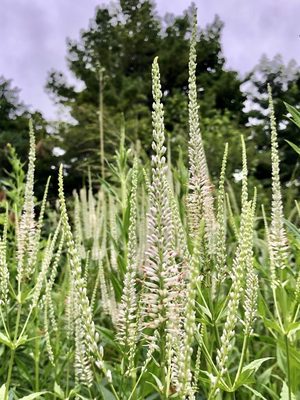
Culver's Root
Veronicastrum virginicum
Elegant white candelabra spires that bring vertical structure and a haze of bees to midsummer.
- Full–part sun
- Average–wet
- 3–5 ft
- Blooms Jun–Aug
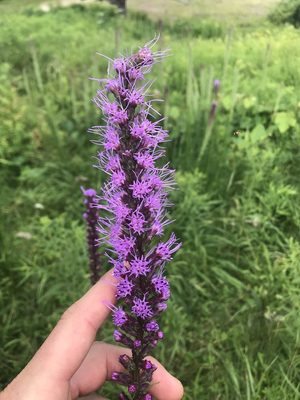
Dense Blazing Star
Liatris spicata
Vertical wands of magenta that open top-down and pull in every swallowtail in the neighborhood.
- Full sun
- Average–wet
- 2–4 ft
- Blooms Jul–Aug
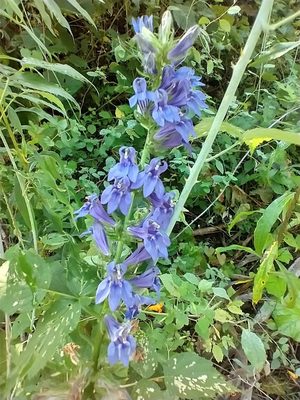
Great Blue Lobelia
Lobelia siphilitica
Spikes of true blue for late summer shade and damp ground, worked hard by bumblebees.
- Full–part sun
- Average–wet
- 2–3 ft
- Blooms Aug–Sep