- Home
- Plant guide
- Wild Ginger
Wild Ginger
Asarum canadense
A lush, heart-leaved carpet for dry shade where lawn and hostas give up.
Native to: the Northeast · the Mid-Atlantic · the Southeast · the Midwest
Growing Wild Ginger
The glossy kidney-shaped leaves make one of the most beautiful native groundcovers for shade. Curious maroon flowers hide at ground level for ground-dwelling pollinators.
Where it belongs
Wild ginger is native to the Northeast, Mid-Atlantic, Southeast, and Midwest, growing on shaded slopes, in rich deciduous woods, and along the banks of wooded streams.
Its use is specific: the deep shade close to a tree trunk, the north side of a house, the ground beneath a dense shrub. These are places where lawn thins to moss and dirt and where most groundcovers sulk. Wild ginger fills them with large, soft, kidney-shaped leaves that look nothing like a struggle.
It is not culinary ginger, which is a tropical plant in a different family. The root smells similar and was used as a seasoning historically, but it contains aristolochic acid, which is toxic to the kidneys. Grow it, do not eat it.
Growing it
Shade to part sun, medium moisture, in loam, zones 3 to 7. Four to eight inches tall, spreading to about a foot and a half.
Leaf litter and shade. It accepts drier conditions than most rich-woodland plants once established, which is why it works under trees where roots take the water.
It spreads by shallow rhizomes at a slow, steady pace, a few inches a year, knitting into a solid mat over time. That slowness is the only drawback: filling an area takes patience or a lot of plants. Space them a foot apart and expect several years to close.
Divide in spring by lifting a section of rhizome with a growing tip and setting it just under the surface.
What it feeds
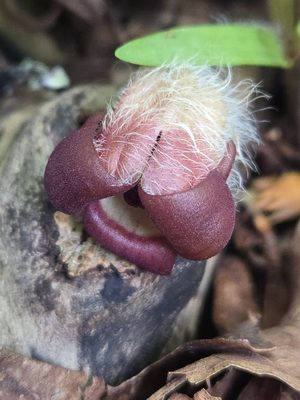
The flowers are the curiosity. They are dull maroon, cup-shaped, about an inch across, and they sit directly on the ground beneath the leaves, so most people who grow the plant have never seen one. Lift the foliage in April and look.
Pollination happens close to the soil surface, involving small flies, fungus gnats, thrips, and beetles moving through the litter layer rather than flying between blooms. Ants carry the seeds away, drawn by an oil-rich attachment, and drop them elsewhere.
It hosts the pipevine swallowtail in parts of its range, though pipevines proper are the primary host.
Living with it
Deer leave it alone.
The leaves are the reason to plant it. They are glossy, substantial, and dark green, and a mature colony reads as intentional and lush in a place that otherwise looks bare.
There is no maintenance. The foliage dies back with hard frost and the leaf litter covers it, which is exactly what should happen.
Sources: USDA PLANTS Database (native range); Lady Bird Johnson Wildflower Center, University of Texas at Austin (species profile and pollination); National Institutes of Health, National Center for Complementary and Integrative Health (aristolochic acid toxicity).
It’s deer-resistant, and easy to grow.Where it grows
Wild Ginger is native to the Northeast. In the wild you’ll find it across Alabama · Arkansas · Connecticut · Delaware · Georgia · Illinois · Indiana · Iowa · Kentucky · Maine and 22 more states. Always confirm it suits your specific county with your state native plant society before planting.
Regional Garden has written state guides covering Wild Ginger in 32 of them so far.
Good for
Where to buy Wild Ginger
Some links here are affiliate links and we may earn a small commission at no extra cost to you.
What a first-year Wild Ginger planting needs, from a pH kit to mulch.
Companions & kin.
Natives that share Wild Ginger’s range and conditions.
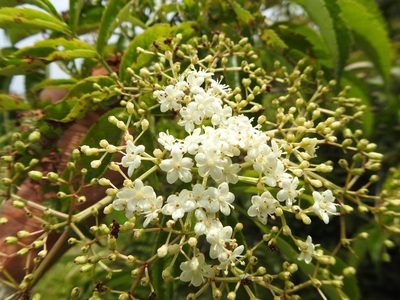
American Elderberry
Sambucus canadensis
Big lacy flower heads in summer give way to purple-black berries for both birds and your kitchen.
- Full–part sun
- Average–wet
- 6–12 ft
- Blooms Jun–Jul

Arrowwood Viburnum
Viburnum dentatum
A bulletproof hedge shrub with white spring flowers, blue fall berries, and burgundy autumn leaves.
- Sun to shade
- Average–wet
- 6–10 ft
- Blooms May–Jun
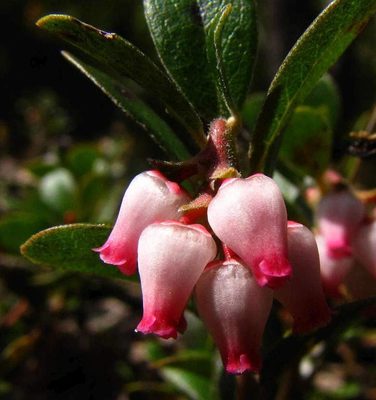
Bearberry
Arctostaphylos uva-ursi
A glossy evergreen mat that grips sandy, sunny banks where nothing else will hold, even by the sea.
- Full–part sun
- Dry
- 4–8 in
- Blooms Apr–May
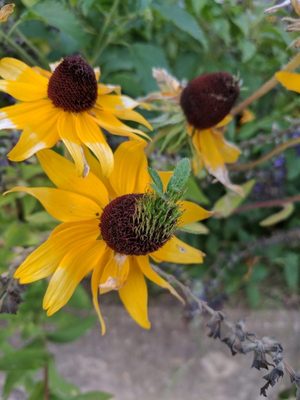
Black-Eyed Susan
Rudbeckia hirta
A cheerful, unkillable starter native that blooms its first year and seeds itself politely around.
- Full–part sun
- Dry–average
- 1.5–3 ft
- Blooms Jun–Sep