- Home
- Plant guide
- Christmas Fern
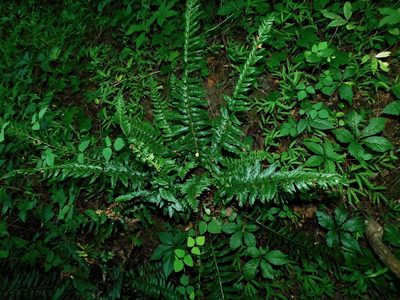
Michael J. Papay (CC BY)
Christmas Fern
Polystichum acrostichoides
A tough evergreen fern that holds its green fronds through winter and grips a shady slope.
Native to: the Northeast · the Mid-Atlantic · the Southeast · the Midwest
Growing Christmas Fern
One of the most adaptable native ferns, taking dry shade and erosion-prone banks in stride. Stays green for winter interest when everything else has died back.
Where it belongs
Christmas fern grows across the Northeast, Mid-Atlantic, Southeast, and Midwest, on wooded slopes, rocky hillsides, ravine banks, and stream bluffs. It is one of the most common ferns in the eastern woods and one of the most adaptable.
The name comes from the fronds staying green into December, which mattered when they were cut for holiday decoration. It is also a useful reminder of the plant's main garden virtue: in January there is something green under the trees.
Growing it
Shade to part sun, medium to dry soil, in loam or rocky ground, zones 3 to 9. One to two feet, arching outward into a vase.
Dry shade is the condition it handles better than nearly any other fern. Most ferns want consistent moisture, and the ground under a mature maple or oak offers the opposite. This one establishes there and persists.
Slopes are the other specialty. The root mass is fibrous and dense and holds soil in place, which makes it a working plant on a bank that erodes in every heavy rain. Plant across the slope rather than in rows down it.
It is slow to establish. Give it two seasons before expecting much, then leave it alone essentially forever. It does not spread aggressively and does not need dividing.
What it feeds
Ferns do not flower, so there is no nectar and no pollinator story here. What they contribute is structure.
The evergreen fronds flatten under snow into a layer of cover at ground level, and that layer shelters overwintering insects, salamanders, and small vertebrates. Ground-feeding birds work under it. Ruffed grouse and wild turkey have been recorded eating the fronds in winter, when little green is available.
In a habitat planting, the shaded ground layer is the part most gardens are missing, and this is one of the plants that builds it.
Living with it
Deer do not eat it, which puts it in a very short list of shade plants that survive real deer pressure untouched.
Identify it by the leaflets: each one has a small lobe at the base pointing toward the frond tip, so it looks a little like a Christmas stocking. It is a reliable field mark.
In early spring, cut the previous year's flattened fronds back before the new fiddleheads unroll. That is the only maintenance it ever asks for, and skipping it costs nothing but tidiness.
Sources: USDA PLANTS Database (native range); Lady Bird Johnson Wildflower Center, University of Texas at Austin (species profile); USDA Natural Resources Conservation Service (plant guide, erosion control and wildlife use).
It’s deer-resistant, evergreen, and easy to grow.Where it grows
Christmas Fern is native to the Northeast. In the wild you’ll find it across Alabama · Arkansas · Connecticut · Delaware · Florida · Georgia · Illinois · Indiana · Iowa · Kentucky and 24 more states. Always confirm it suits your specific county with your state native plant society before planting.
Regional Garden has written state guides covering Christmas Fern in 34 of them so far.
Good for
Where to buy Christmas Fern
Some links here are affiliate links and we may earn a small commission at no extra cost to you.
What a first-year Christmas Fern planting needs, from a pH kit to mulch.
Companions & kin.
Natives that share Christmas Fern’s range and conditions.
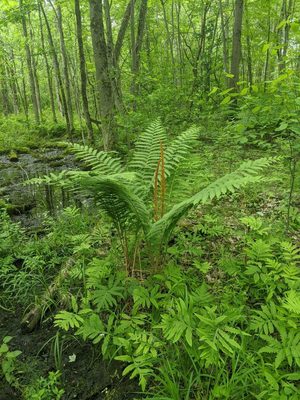
Cinnamon Fern
Osmundastrum cinnamomeum
A bold architectural fern for wet shade, with cinnamon-colored fertile fronds in spring.
- Part shade
- Average–wet
- 2–4 ft
- Foliage
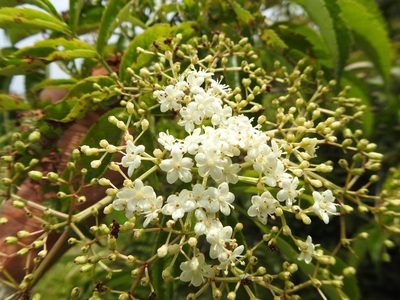
American Elderberry
Sambucus canadensis
Big lacy flower heads in summer give way to purple-black berries for both birds and your kitchen.
- Full–part sun
- Average–wet
- 6–12 ft
- Blooms Jun–Jul

Arrowwood Viburnum
Viburnum dentatum
A bulletproof hedge shrub with white spring flowers, blue fall berries, and burgundy autumn leaves.
- Sun to shade
- Average–wet
- 6–10 ft
- Blooms May–Jun
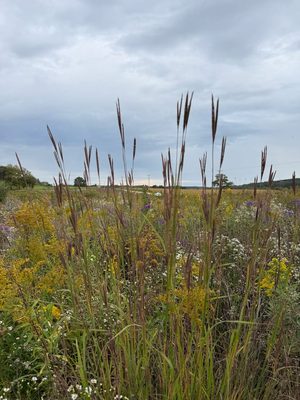
Big Bluestem
Andropogon gerardii
The towering 'turkey-foot' grass that once defined the tallgrass prairie, head-high by fall.
- Full sun
- Dry to wet
- 4–7 ft
- Fall color