- Home
- Plant guide
- Trees, vines and groundcovers
Trees, vines & groundcovers
The vertical extremes. Small trees carry the most caterpillars per plant of anything here, vines cover surfaces nothing else will, and groundcovers replace mulch permanently.
Three groups, one thing in common
They are the plants that work in the dimensions a border does not: overhead, against a vertical surface, and flat across bare ground.
The small trees here run fifteen to thirty feet, the scale that fits an ordinary yard where an oak does not. The vines climb by twining, by tendrils, or by adhesive pads. The groundcovers spread laterally into a continuous low layer.
Small trees carry the most weight per plant
If a yard has room for one thing that matters ecologically, this is the category.
Insects specialize on the plants they evolved with, and native woody plants support caterpillar communities that introduced ornamentals do not. Serviceberry and flowering dogwood each support well over a hundred butterfly and moth species. A chickadee pair needs six to nine thousand caterpillars to raise one brood, and that supply comes from plants like these rather than from a feeder.
They deliver on the ordinary measures too. Serviceberry flowers in April, fruits in June, and colors orange in fall. Eastern redbud flowers straight out of its bare trunk in March, ahead of nearly every other tree, feeding the first bees. Desert willow shades a hot yard on no irrigation.
How a vine climbs decides where it can go
This is the practical question, and it comes before flower color.
Twining vines wrap around thin supports and need a trellis, wire, or post. Trumpet honeysuckle is one, and it will not climb a flat wall or damage siding.
Vines with adhesive pads attach directly to brick, stone, wood, and stucco with no help at all. Crossvine and Virginia creeper both do, and that convenience is also the caution: they get into siding, gutters, and under shingles, and pulling them off painted surfaces takes the paint. Give them a fence, an arbor, a masonry wall, or a dead tree.
All of them need one pass a year with the pruners to stay where you meant them.
Groundcovers replace an annual expense
The standard planting is specimens in bark mulch, refreshed every spring forever. A living layer does the same work permanently: shading soil, suppressing weeds, slowing erosion, and getting denser rather than thinner.
Match the species to the site, because these are the plants most often installed in the wrong conditions. Pennsylvania sedge, wild ginger, and Christmas fern for dry shade; foamflower for moist shade; creeping phlox and low fragrant sumac for a hot dry slope; bearberry for cold sandy exposed ground.
The whole difficulty is the first two or three years, before the plants knit together. Closer spacing closes faster and costs more. Weed through establishment and water through the first season, and after that the layer takes care of itself.
Sources: Doug Tallamy and University of Delaware research on native woody plants and caterpillar production; Lady Bird Johnson Wildflower Center, University of Texas at Austin (species profiles and climbing habits); Mt. Cuba Center (groundcover trials on rate of spread and coverage); Cornell Lab of Ornithology (nestling diets).
10 species
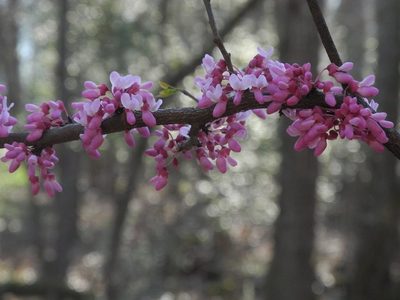
Eastern Redbud
Cercis canadensis
Bare branches erupt in rose-magenta in early spring, and the flowers feed the season's first bees.
- Full–part sun
- Dry–average
- 20–30 ft
- Blooms Mar–Apr
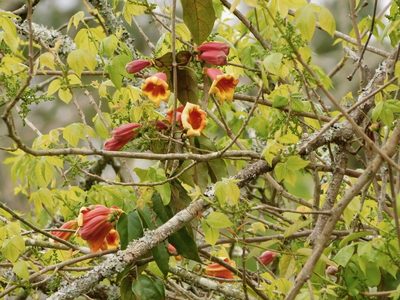
Crossvine
Bignonia capreolata
A vigorous, semi-evergreen climber that smothers a fence in orange-red trumpets each spring.
- Full–part sun
- Dry–average
- 25–50 ft
- Blooms Apr–May
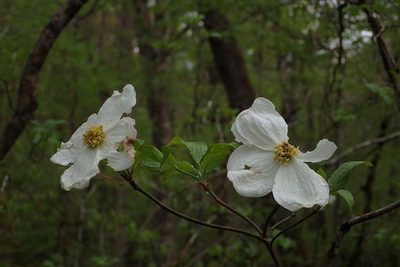
Flowering Dogwood
Cornus florida
The classic understory tree of the eastern woods, with white spring bracts and crimson fall leaves.
- Part shade
- Average
- 15–25 ft
- Blooms Apr–May
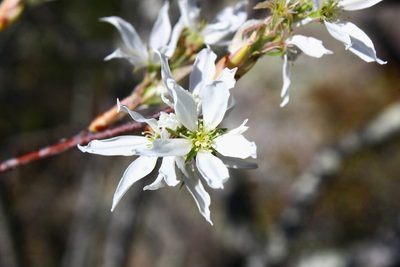
Serviceberry
Amelanchier canadensis
A small four-season tree: white spring flowers, June berries for the birds, and fiery fall color.
- Full–part sun
- Average–wet
- 15–25 ft
- Blooms Apr–May
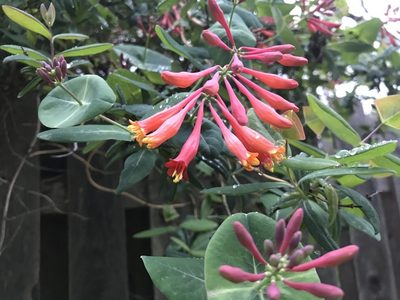
Trumpet Honeysuckle
Lonicera sempervirens
A well-mannered native vine that pours out coral-red hummingbird trumpets from spring to frost.
- Full–part sun
- Dry–average
- 8–15 ft
- Blooms Apr–Sep
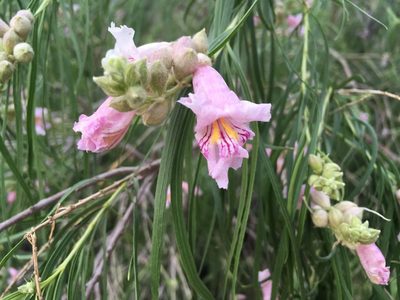
Desert Willow
Chilopsis linearis
A graceful desert tree hung with orchid-like trumpets all summer, fueled by nothing but heat.
- Full sun
- Dry
- 15–25 ft
- Blooms May–Sep
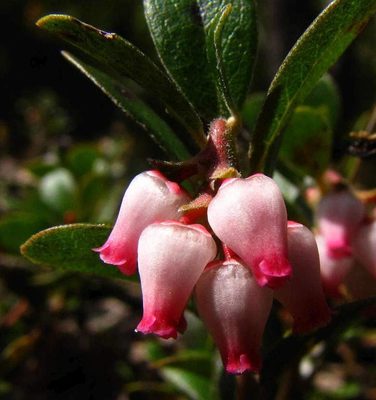
Bearberry
Arctostaphylos uva-ursi
A glossy evergreen mat that grips sandy, sunny banks where nothing else will hold, even by the sea.
- Full–part sun
- Dry
- 4–8 in
- Blooms Apr–May
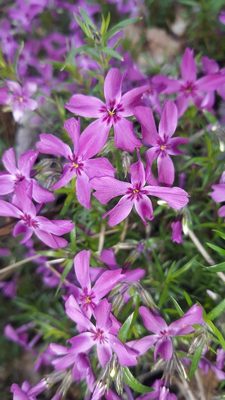
Creeping Phlox
Phlox subulata
A sheet of spring color that spills over walls and stitches a dry, sunny slope together.
- Full–part sun
- Dry–average
- 4–8 in
- Blooms Apr–May
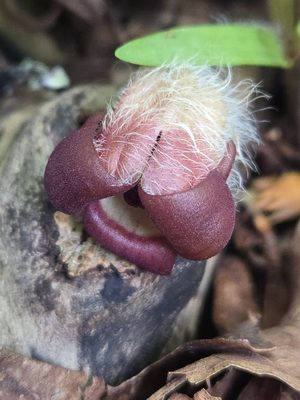
Wild Ginger
Asarum canadense
A lush, heart-leaved carpet for dry shade where lawn and hostas give up.
- Part shade
- Average
- 4–8 in
- Blooms Apr–May
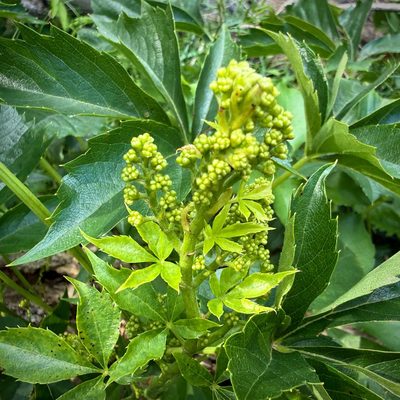
Virginia Creeper
Parthenocissus quinquefolia
A tough native climber grown for spectacular scarlet fall color and berries that 35+ bird species eat.
- Sun to shade
- Dry–average
- 30–50 ft
- Blooms Jun